
Thermal Inspection Advantages
Thermal inspection advantages: failures in solar panels can seriously reduce energy production over time and may even cause fire if left unchecked.
Thermal inspection answers a narrow question well: which parts of a large operating array are running warmer than their neighbors under comparable conditions. That makes it a screening method for O&M teams that cannot walk every row, not a verdict on any single module. The sections below cover what the imagery can show, when a drone survey earns its cost, and which conclusions have to come from electrical testing instead.
When Thermal Drone Inspection Is the Right Choice
Thermal drone inspection is most useful when an O&M team needs to screen a large operating PV field for temperature patterns that may point to localized electrical or module-level anomalies. The method becomes especially attractive when walking every row with a handheld camera would take too long, require more field labor, or make it difficult to preserve a consistent viewing geometry across the site. A drone can cover large areas quickly from above while collecting thermal and visible imagery that can be tied back to specific parts of the array.
The decision should start with the maintenance question, not with the aircraft. If the goal is to confirm an electrical fault or diagnose an inverter alarm, direct electrical measurements may be more appropriate. Thermal inspection helps narrow the field of investigation; it does not replace electrical testing or establish the root cause of every abnormal temperature pattern.
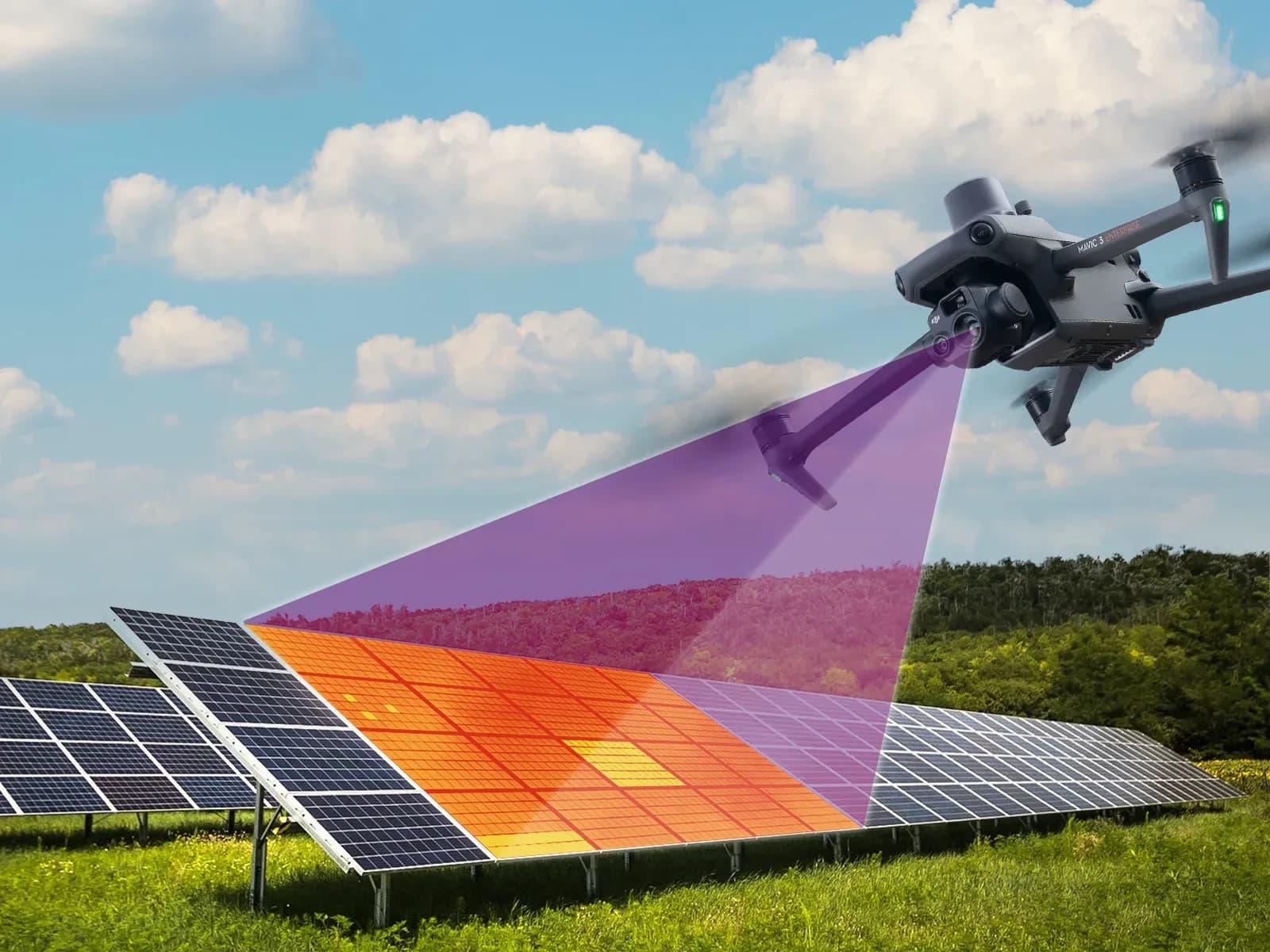
What Thermal Imaging Can Reveal on an Operating PV Array
Infrared imaging records surface temperature differences. On an operating PV array, those differences can reveal hotspots or other patterns associated with cells, interconnections, bypass-diode behavior, shading, damaged areas, soiling, or circuit conditions. A cell-area anomaly can be visible when the thermal resolution, flight height, viewing angle, irradiance, wind, and module operating state make that feature large enough to resolve.
For crystalline-silicon modules, higher cell temperature at comparable irradiance generally reduces power, but that relationship does not let an image assign root cause. The important word is "associated." A warm cell or module does not prove a specific failure by itself, and a normal-looking thermal image does not prove that a module is electrically healthy. Thermal evidence should be interpreted with visible imagery, plant monitoring data, the physical layout of the array, and follow-up inspection where the consequence of a suspected defect justifies it.
This is why useful reporting separates observation from diagnosis. A report can state that a module contains a localized high-temperature region relative to nearby modules under comparable conditions. It should not automatically label that observation as a failed diode, cracked cell, reverse-current condition, or warranty defect unless additional evidence supports that conclusion.
Why Drones Are Useful on Large Solar Sites
The operational advantage of a drone is coverage. Utility-scale PV sites can occupy hundreds of acres, with long rows and repeated module geometry that make manual screening labor-intensive. Aerial thermography lets the inspection team capture many modules from a repeatable path while reducing the amount of row-by-row camera handling required on the ground.
That can reduce survey time and field cost compared with manual thermography on large sites, but the size of the benefit is installation-dependent. Terrain, airspace, row spacing, obstacles, flight restrictions, weather, vegetation, array orientation, and the required ground sampling distance all affect how much can be covered in a usable flight. A small rooftop or a site with difficult airspace may not gain the same advantage as a large, accessible ground-mounted plant.
Thermal observations can be paired with visible imagery and location data, making it easier for technicians to return to the correct row or module. This can be useful after visible bird damage, lightning exposure, or other localized events. The value comes from reducing search space and organizing evidence, not from treating the drone image as the final diagnosis.
Conditions Matter More Than the Camera Alone
Thermography is sensitive to operating and environmental conditions. IEC 62446-3 addresses outdoor thermographic inspection of operating PV systems, including equipment, environmental conditions, inspection procedure, personnel competence, and reporting. It does not define a software algorithm, and it does not impose one universal module-temperature range for every plant.
For field work, the inspection team needs conditions that allow meaningful temperature differences to develop and remain interpretable. Irradiance, wind, cloud movement, module temperature, reflections, viewing angle, and rapid changes in operating state can all affect what appears in the image. Two flights taken under very different conditions should not be treated as directly comparable simply because the same camera and route were used.
Image quality must also be judged against the target feature size. If the acquisition cannot resolve a cell-area feature, software cannot recover information that was never captured. Sensor resolution, flight height, and optics together determine how much of the module is represented in the image.
Where Thermal Inspection Fits in O&M Decisions
O&M teams can use thermal drone inspection in planned surveys, post-event checks, or targeted investigations prompted by monitoring data. A scheduled survey can create a documented snapshot of the array under defined conditions. A targeted survey can focus on strings, rows, or blocks that show an unexplained production deviation or that were exposed to an event such as hail, lightning, nearby construction, or visible physical damage.
For repeat surveys, consistency matters. Recording the environmental conditions, flight parameters, inspected area, and modules that could not be assessed gives the next inspection a usable reference point. Without that context, an apparent change may come from weather or acquisition geometry rather than from the PV equipment.
Inspection frequency should therefore be tied to site conditions, contracts, monitoring signals, and risk rather than to a fixed calendar rule. The related guide on how often solar power plants should be inspected by drones explains the factors that can move the interval up or down.
What Thermal Inspection Does Not Replace
Thermal imagery is one layer of evidence. It does not replace IV-curve tracing, insulation testing, string-current measurements, torque checks, visual inspection, or other electrical and mechanical procedures when those methods are needed to confirm condition or root cause. It also cannot show every degradation mechanism, especially when a defect does not create a detectable surface-temperature difference during the survey.
A single inspection is not continuous monitoring. A module can operate normally during the flight and develop a fault later, or an intermittent condition may not be active when the drone passes. For that reason, plant monitoring data and maintenance history remain important even when aerial thermography is part of the O&M program.
The same caution applies to safety decisions. A hotspot may justify prompt field review because abnormal heating can be relevant to electrical or fire risk, but the image alone does not determine the severity, cause, or required corrective action. Those decisions belong to qualified personnel using the site context and appropriate follow-up tests.
Turning Thermal Data Into Actionable Inspection Records
A useful output connects each observation to a physical location and preserves enough context for another person to review it. At minimum, the record should make clear where the anomaly was found, what thermal pattern was observed, what visible evidence was available, and under what acquisition conditions the image was captured. If a module or area could not be inspected reliably, that limitation should be stated rather than hidden.
Software can help organize imagery, map observations, compare nearby modules, and prepare inspection records.
For an O&M team deciding whether to use a drone, the practical question is straightforward: does aerial thermal coverage help narrow a large inspection problem into a smaller set of locations that technicians can verify? When the site, operating conditions, and inspection objective support that workflow, thermal drone inspection can shorten field screening and improve traceability. When the question requires direct electrical confirmation, the drone should feed the next diagnostic step rather than substitute for it.