
How Often Solar Power Plants Should Be Inspected by Drones
How often solar power plants should be inspected by drones: regular maintenance and inspections increase efficiency and reduce operating costs.
Owners usually ask for a number of months. The more useful answer is the set of inputs that move that number: plant data, site exposure, layout, contracts and the cost of missing a defect. A single fixed interval copied from another site hides the reason the schedule exists, so this article works through the inputs one by one and ends with a schedule that mixes planned and triggered surveys.
Start With the Plant, Not a Generic Calendar
There is no single drone-inspection interval that fits every PV plant. The useful interval depends on the plant layout, operating history, environmental exposure, monitoring coverage, contractual requirements, and the consequence of leaving a defect undetected. A site owner should treat the schedule as a maintenance decision that can change as evidence accumulates.
A calendar can still provide a baseline. The point is that the baseline should be justified by the site rather than copied from another plant. A newly commissioned array with detailed string-level monitoring may be managed differently from an older site with limited telemetry, repeated storm exposure, difficult ground access, or a history of localized module damage.
Drone thermography should also be separated from continuous monitoring. A flight records conditions at a particular time. It can reveal thermal patterns present during that survey, but it cannot observe what happens between inspections.
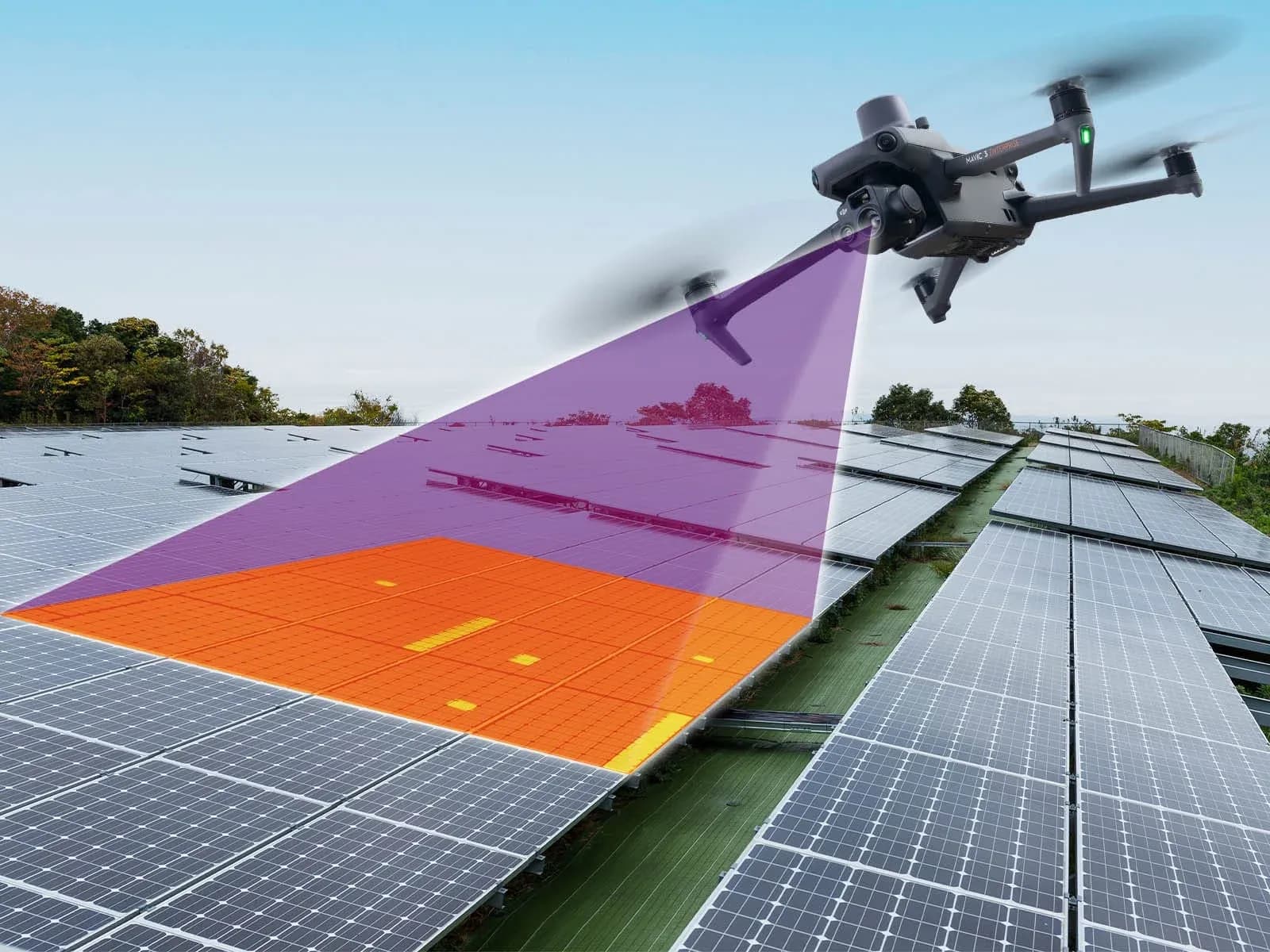
Monitoring Data Can Move the Next Inspection Forward
Where string-level or comparable plant monitoring is available, deviations can be used to trigger targeted inspection before the next planned survey. A persistent difference between comparable strings, an unexplained production change, or a new alarm may justify looking at a specific block instead of waiting for the calendar. The inspection objective then becomes narrower: locate visible or thermal evidence that helps explain the operational signal.
Monitoring does not identify every module-level problem, and thermography does not explain every monitoring anomaly. The two sources are most useful when they constrain each other. Plant data identifies where behavior changed; aerial imagery can then show whether a spatial or thermal pattern exists in the same area.
Where monitoring is limited, the inspection interval carries more of the detection burden. That does not mean the owner should automatically fly more often, but it does mean there is less information available between surveys. The acceptable gap should therefore reflect how much uncertainty the owner is willing to carry and how quickly a missed condition needs to be found.
Site Conditions Change the Value of a Fixed Interval
Plant size and layout influence how practical repeated drone coverage will be. Large ground-mounted sites can benefit from consistent aerial routes because many rows can be screened without moving a handheld camera through the full array. Rooftops, steep terrain, irregular row spacing, nearby obstacles, or restricted airspace can change the balance between aerial and ground inspection.
Environmental exposure matters as well. Hail, dust, storms, vegetation growth, nearby construction, or recurring soiling can create reasons to inspect outside the normal schedule. These factors do not create a universal rule such as "inspect every X months." They change the probability that useful new information will be found before the next planned survey.
Module type, mounting configuration, site drainage, shading, and access also affect what can be seen and how easily a suspected location can be checked afterward. An interval only makes sense if the chosen inspection method can produce interpretable data under the conditions in which the plant is operated.
Events That Justify an Unplanned Drone Survey
Some events are better treated as inspection triggers than as reasons to redesign the entire calendar. After significant hail, a severe storm, lightning exposure, a fire or electrical incident, or visible mechanical damage, a targeted drone survey can document the affected area and help prioritize field checks. Nearby construction or rapidly changing vegetation can also justify a review when there is a plausible impact on modules, cabling, access, or shading.
Warranty, insurance, commissioning, or service-contract milestones may create their own inspection requirements. Those requirements should be read from the actual contract or policy; they should not be inferred from a generic maintenance article. A drone survey can support the required record when its scope matches the obligation, but it does not create or replace the obligation itself.
An event-driven survey should still have a defined question. "Inspect after the storm" is too broad unless the team also identifies the affected blocks, the expected evidence, and the conditions needed for valid thermal acquisition. This keeps the flight tied to a decision instead of producing a large image set with no clear follow-up path.
Thermal Survey Conditions Must Be Comparable
For thermal inspection, frequency alone is not enough. The record needs the date and time, irradiance, module temperature, wind and cloud conditions, relevant flight parameters, and the parts of the plant that could not be inspected. Without this context, two surveys made months apart may look different because the environment changed rather than because the modules changed.
IEC 62446-3 addresses outdoor thermographic inspection of operating PV systems, including equipment, environmental conditions, procedures, personnel competence, and reporting. It does not define one universal temperature range for every plant, and it does not prescribe a single drone-inspection interval for all PV sites. The inspection plan therefore has to connect the standard's measurement discipline with the actual operating conditions of the plant.
Repeatability is especially important when trend comparison is part of the reason for flying. Similar routes and suitable acquisition settings help, but they do not make dissimilar weather conditions equivalent. If conditions make the thermal data unreliable, postponing or qualifying the survey can be more useful than completing it simply to satisfy a date on the calendar.
Use Inspection History to Adjust the Schedule
The first useful schedule is provisional. After several inspection cycles, the owner can review what was found, which findings required action, which areas repeatedly produced observations, and whether monitoring data had already identified the same locations. If repeated surveys add little new information under otherwise stable conditions, the interval may deserve review. If important observations repeatedly appear between planned surveys, the interval or trigger criteria may need to tighten.
The record should distinguish between confirmed defects, observations awaiting follow-up, inaccessible modules, and findings later shown to be non-defects. That distinction prevents the inspection history from becoming a count of thermal images rather than a maintenance record.
Owners should also avoid treating one clean survey as proof that the next survey can be delayed indefinitely. A single inspection is a snapshot, not a guarantee about future operation. Component condition, weather exposure, vegetation, and electrical behavior can change after the flight.
Build a Schedule With Planned and Triggered Inspections
A practical program combines a planned baseline with explicit conditions for additional inspection. The baseline gives the team a predictable opportunity to review the array, while trigger criteria allow the schedule to react to plant evidence. Those triggers can include monitoring deviations, severe weather, visible damage, electrical incidents, or contract-defined milestones.
For each planned survey, define the area to be covered, the data that must be recorded, the minimum conditions for useful thermal acquisition, and how unresolved observations will be verified. For each triggered survey, state what changed and which part of the plant needs examination. This keeps inspection scope proportional to the problem.
Drone thermography should remain one component of the maintenance program. It does not replace electrical tests, ground inspection, plant monitoring, or qualified engineering judgment when those are required. The companion article on thermal inspection advantages explains where aerial thermography adds value and where its evidence needs follow-up.
The right interval is therefore the one the owner can defend from site conditions, plant data, inspection history, and contractual obligations. It should be reviewed when those inputs change. A schedule built this way is more useful than a universal frequency because it defines both when to inspect and why the next inspection is being performed.