
Building a Digital Twin of Your Solar Plant
What a digital twin of a solar plant holds, which data it needs, how current it really is, and how campaigns turn module-level findings into a plant record.
Quick answer
A digital twin of a solar plant is a structured model of its physical assets, strings, modules, inverters and cabling, that each inspection campaign updates. Findings, serial numbers and measurements are stored against the component they belong to, so the plant keeps one continuous history that is current as of the last campaign ingested.
TL;DR
- A solar digital twin is an identity and evidence record of the plant, not a real-time simulation of its electrical behavior, and the term is not defined by the IEC 62446 series.
- It holds four layers: module map, component and serial records, inspection and measurement history, and work order status.
- It is current as of the last campaign ingested, not live; freshness is a scheduling decision an owner has to own.
- Findings must be anchored to stable module identities, and campaigns are only comparable when capture conditions and analysis level are comparable.
- Data ownership, export of module identities and an audit trail decide whether the record survives a change of provider or owner.
A digital twin is the layer underneath everything else a solar operator does with inspection data. The thermal analysis described in how AI-assisted thermography detects solar panel faults produces the findings, and the documentation rules in understanding IEC 62446-3 inspection reports decide how a single campaign is written up. The twin is what keeps both useful after the campaign closes.
The distinction is not cosmetic. A report answers what the plant looked like on one day. A record that survives across campaigns answers whether the plant is getting better or worse, which is the question maintenance budgets, warranty discussions and acquisitions actually turn on. This article is a supporting guide to that record; the product view of the workflow sits on the solar panel inspection software page.
What Is a Digital Twin of a Solar Plant?
A digital twin of a solar plant is a structured record of its physical assets: strings, modules, inverters and the electrical infrastructure that connects them. Instead of a static as-built drawing, it is a model that each inspection campaign updates, so the plant has one place where identity, findings, measurements and repairs live together.
The word twin is often read as a real-time simulation of the plant's electrical behavior. That is a different product. In an inspection and asset-management context the twin is an identity and evidence model: it knows which module sits where, what has been found on it, what was measured and what was done about it. It does not predict tomorrow's generation curve.
It is also worth being precise about the vocabulary. Digital twin is an industry and product term, not a term defined by the IEC 62446 series. The standards referenced in this article govern the documentation and inspection layers such a record stores, not the concept itself, and there is no single agreed definition of what a solar digital twin must contain. That is a practical problem when comparing vendors: ask which of the layers below a given product actually holds, rather than whether it uses the word.
How Is It Different From an As-Built Drawing, a GIS Layer, a CMMS or a Folder of Reports?
Most plants already have some of the pieces, which is why the term causes confusion.
An as-built documentation set records how the plant was constructed. It is authoritative at handover and static afterwards, and IEC 62446-1 describes what that documentation set covers. A GIS layer places assets accurately in space but usually carries no inspection history and no component attributes beyond location. A CMMS tracks work orders and maintenance activity, often without a module-level identity to attach a finding to. A folder of inspection reports holds the evidence but not the continuity: every document is a separate island, and comparing two of them is a manual exercise. A monitoring platform sees production in real time; module-level loss localization depends on the monitoring hardware and data granularity, and production data alone does not confirm a physical cause.
The twin is the layer that joins them: a stable module identity that inspection findings, measurements and work orders can all attach to. It does not replace the others, and a vendor claiming that it replaces all of them is selling a category, not a product.
What Does the Record Contain?
Four layers, and a record missing any one of them stops answering useful questions quickly.
Plant layout and module identity
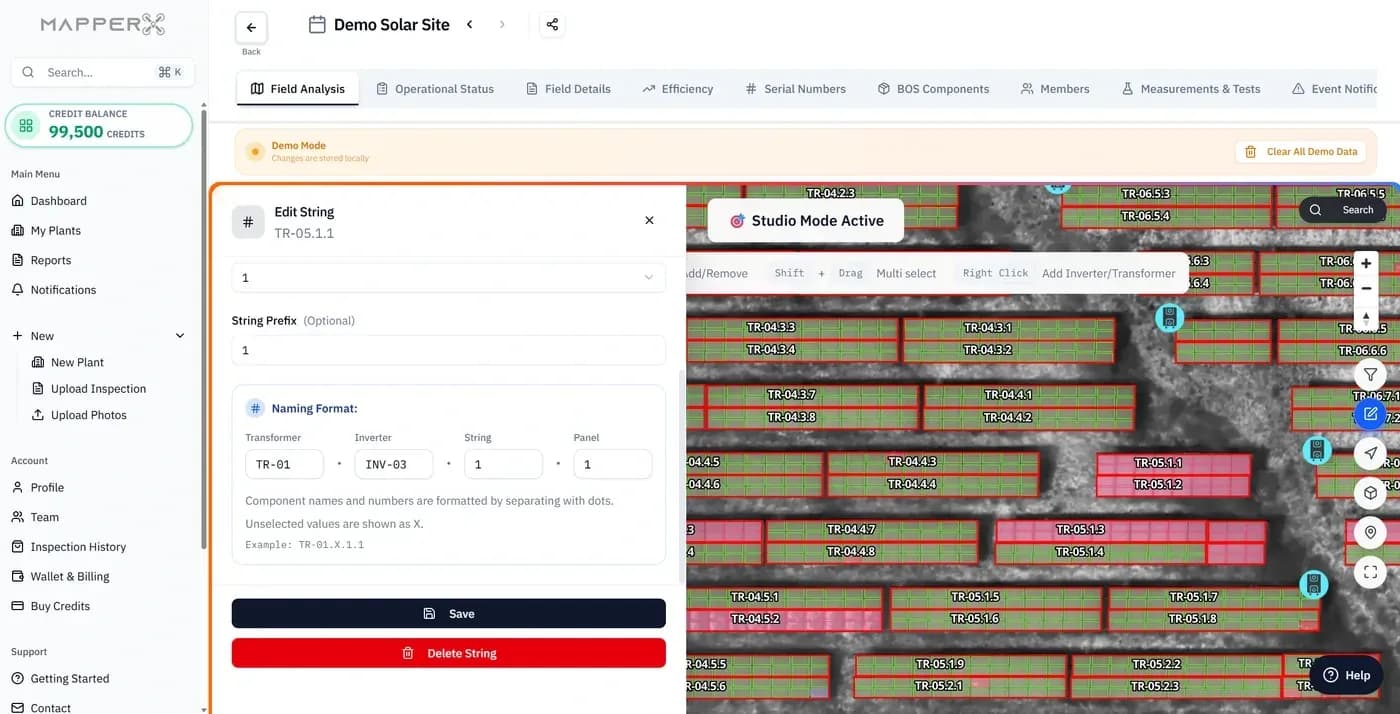
The base layer is a georeferenced orthophoto of the site with every module segmented and given a stable identifier tied to its position in the layout. This is what everything else attaches to. Positioning quality decides how reliable it is, which is why RTK Fix capture, which can provide centimeter-level image positioning under suitable conditions, is the recommended basis for a module map. Module-level attribution also depends on acquisition quality, processing and validation.
Component and serial number records
Modules, inverters, combiners and cabling carry their own attributes: manufacturer, model, serial number where it is available, installation date and warranty status. Serial number records are what allow a defect pattern to be traced back to a production batch, which is the difference between replacing one module and identifying a systematic supply problem. Whether serials can be captured at all depends on how the plant was documented at handover and on what is physically readable in the field, so treat this layer as something to be populated deliberately rather than as something that appears automatically.
Inspection and measurement history
Every campaign writes into the same model: thermal findings with their classification, RGB evidence, electrical tests and any measurement carried out on site. Because these are stored against the component rather than against the campaign, a module accumulates a history instead of appearing in a series of unconnected documents. The failure modes that history tends to surface are documented in the IEA PVPS Task 13 review of photovoltaic module failures.
Work orders and resolution status
The last layer is what happened next. A finding that was verified, repaired and re-checked means something different from an identical finding that is still open, and only the resolution status distinguishes them. Without this layer a twin becomes a growing list of problems with no information about which ones were solved.
In data terms the chain is simple to state and easy to get wrong: plant, inverter, string, module, serial number, finding, test, repair. Every one of those needs an identifier that survives the next campaign.
How Current Is "Current"?
A twin reflects the plant as of the most recent campaign that was captured, reviewed and ingested. It is exactly as current as its last ingest, and nothing in the model observes the plant on its own. A module that failed the week after the last flight reads as healthy until the next one.
That has two practical consequences. Freshness is a scheduling decision and an owner's responsibility, not a property of the software, so somebody has to own the cadence. And every view of the record should carry the date of the campaign it came from, because a finding without a date invites the reader to assume it is live.
How Is the Record Built From Inspection Data?
It is built from the first campaign that establishes module identity, and extended by every campaign afterwards. The initial flight produces the orthophoto and the segmented module map, and components are matched to that map. From then on, each new inspection writes its findings to existing module identities rather than creating a new dataset.
That sequencing is what makes the model affordable to maintain. The expensive part is done once, when the layout is established and the components are matched. A follow-up campaign only adds a layer of findings, which is why extending a record costs far less than building one, and why postponing the first structured campaign is usually a false economy.
Why Module Identity Decides Whether It Works
Module identity is the single design decision that determines whether a plant record survives more than one campaign. Findings anchored to a stable module reference can be compared over time; findings anchored to image file names cannot, because the next flight renames every frame.
This is also where positioning quality shows up commercially. When images are captured without a proper RTK Fix, the risk of findings drifting onto neighboring modules increases, and a drifted finding does not just send a technician to the wrong panel: it corrupts the history of two modules at once, the one that did not have the fault and the one whose fault was never recorded. Correcting that later is far harder than re-flying the block.
What Questions Can It Answer That a Single Report Cannot?
A record answers questions that need more than one point in time. A single report can tell you that eleven modules in block C show bypass-diode patterns. Only a continuous record can tell you whether those are the same eleven modules as last season, whether a repair held, and whether block C is moving differently from blocks A and B.
- Recurrence. Which findings keep coming back on the same components after repair, which points at a systematic cause rather than a one-off failure.
- Repair verification. Whether a module that was fixed still reads clean in the next campaign, which supports repair verification under comparable conditions but does not replace appropriate field checks and electrical testing.
- Trend. Whether the share of affected modules is growing, stable or shrinking across seasons, measured on the same population rather than on whatever was flown that year.
- Batch correlation. Whether defects cluster by manufacturer, model or serial number range, which is what turns individual failures into a warranty conversation.
Answering these questions from a folder of PDFs requires cross-campaign comparison and reliable component references; well-written individual reports alone do not provide that continuity.
Comparing Campaigns Without Fooling Yourself
A trend line is only as good as the comparability of the campaigns behind it. Thermal findings depend on irradiance, wind, ambient temperature, the plant's operating state and the ground sample distance flown, and two campaigns that differ on those inputs are not directly comparable however neatly the counts line up.
Three habits keep comparisons honest. Fly follow-up campaigns in a similar seasonal and irradiance window to the baseline. Record the capture conditions with every campaign, so a later reader can see why two numbers differ. And treat a change in analysis level, from a 5 cm screening workflow to a 3 cm detailed one, as a change in what the data can see rather than as a change in the plant: a finer level will surface patterns the coarser one could not resolve, and that is not degradation.
Anything the record cannot normalize should be stated rather than smoothed. A degradation claim built on incomparable campaigns is worse than no claim, because it looks quantitative.
Data Quality: What the Record Cannot Fix
A digital twin is not a guarantee of data quality. A model built from campaigns flown under unstable irradiance, with incomplete coverage or with degraded positioning, accumulates unreliable history faster than a paper archive would, because the errors look structured. Discipline about capture conditions and re-flight criteria matters more, not less, once the data feeds a permanent record.
It is also not a substitute for field verification. Thermal patterns indicate suspected anomalies; qualified personnel and electrical testing confirm what they mean. A record that stores suspicion as fact will mislead consistently, which is worse than a report that misleads once. Findings should keep their status, suspected or confirmed, for as long as they are stored.
Ownership, Export, Access and Auditability
A plant record only compounds in value if it stays available across changes of provider, of O&M contractor and of owner. Four questions decide that, and all four belong in a contract rather than in a conversation after the fact.
Do you receive structured findings and the underlying imagery, or only rendered documents? Are the module identities exportable, so a history can move with the asset? Who can see, edit and close a finding, and is that recorded? And is there an audit trail linking a conclusion back to the frame it came from and forward to the work order that closed it?
Asset transactions are where this surfaces most sharply. Technical due diligence on a plant with a comparable multi-campaign record can be done from the record; on a plant with a stack of unconnected reports it usually means re-flying the site, which is a cost and a delay in the middle of a transaction.
Where It Fits Next to a Compliance Report
The record and the compliance report are complementary rather than competing outputs. A standard-aligned report has to document one campaign completely: its scope, its conditions, the equipment and personnel, and every identified abnormality with its class and position. The record is where that campaign is stored afterwards so the next one can build on it.
The practical benefit is consistency. When every campaign writes to the same module map with the same classification vocabulary, reports stay comparable between sites and between seasons. Where a national regime reserves an inspection to an accredited body, that body still performs and issues the regulated inspection; the record holds the technical evidence that supports it, and accreditation attaches to the body and its scope rather than to the software.
Integration Limits and What to Ask a Vendor
Integration is where expectations usually outrun reality, so it is worth asking directly rather than assuming. Which of the four layers does the product actually hold, and which does it expect another system to hold? Can findings be pushed into the CMMS that field teams already use, or only exported? Does monitoring data flow in, and at what granularity? Are module identities stable across a re-segmentation, or does a new orthophoto renumber the plant? What happens to the record at the end of the contract?
None of these questions is adversarial, and a vendor that answers them plainly is easier to work with over five campaigns than one that answers every question with the word integrated. In MapperX the layout, the component records and the inspection history sit in one model. MapperX analysis is AI-assisted and human-reviewed; results depend on conditions, acquisition quality and validation. The MapperX platform page documents the current feature set; credit-based MapperX plans price analysis per campaign, so the record can be extended at whatever cadence a site's risk profile justifies.
How Do You Start If You Only Have PDFs?
Start with the next campaign rather than with the archive. Establishing the module map and the component records from a current, well-captured flight is faster and more reliable than reconstructing identities from historical reports that were never anchored to a stable reference in the first place.
A workable starting sequence looks like this:
- Fly one complete, well-conditioned campaign and accept it only if the capture conditions and coverage hold up.
- Segment the plant and fix stable module identifiers before any findings are written.
- Populate component records where the data exists, and mark the gaps rather than guessing.
- Attach historical findings selectively, for known problem areas, repairs under warranty and any dispute still open.
- Agree who owns freshness, who closes findings, and how the record is exported before the second campaign, not after it.
Everything else in the archive is best treated as background. The value of the record begins accumulating from the first structured campaign, and the second campaign is the one that starts answering questions no single report could.
Key facts
- Model scope
- Strings, modules, inverters and connecting electrical infrastructure
- Positioning basis
- Georeferenced orthophoto and segmented module map, RTK Fix recommended for module-level attribution
- Update cadence
- Extended by every campaign, not rebuilt from scratch each time
- Data freshness
- Current as of the most recent campaign captured, reviewed and ingested; not live plant state
- Records held
- Findings and their class, serial numbers where available, electrical tests and resolution status
- Comparability
- Requires stable module identity plus comparable capture conditions and analysis level
Folder of reports vs. continuous plant record
| Folder of reports | Digital twin record | |
|---|---|---|
| Unit of storage | One document per campaign | One history per component |
| Repair verification | Manual cross-reading of two reports | Status tracked on the same module identity |
| Trend analysis | Requires extracting or manually comparing data across reports | Same population compared across campaigns, conditions permitting |
| Warranty evidence | Scattered across documents | Findings grouped by serial number and batch where serials exist |
| Data freshness | As of whichever document you opened | As of the last campaign ingested, shown with its date |
| Handover to a new owner | Files transfer, context does not | Structured record transfers if identities are exportable |
Building the record, campaign by campaign
- 01
Map the plant
Capture a georeferenced orthophoto and segment every module into a layout map with stable identifiers, which is the layer all later data attaches to.
- 02
Identify modules and components
Match modules, inverters and combiners to the map with manufacturer, model, serial number where available, installation date and warranty status, and mark the gaps rather than guessing.
- 03
Write findings against components
Store thermal findings, RGB evidence and electrical measurements on the component they belong to rather than on the campaign that produced them, keeping each finding marked as suspected or confirmed.
- 04
Compare campaigns and trend the plant
Run follow-up campaigns into the same model under comparable conditions, then read recurrence, repair verification and trend across a consistent module population.
Technical details
What each layer of the record holds
| Layout layer | Georeferenced orthophoto, segmented modules, stable module identifiers |
|---|---|
| Component layer | Manufacturer, model, serial number where available, installation date, warranty status |
| Inspection layer | Thermal findings, abnormality class, RGB evidence, capture conditions and campaign date |
| Measurement layer | Electrical tests and on-site measurements logged against components |
| Work layer | Verification, repair, resolution status and re-check result |
| Governance layer | Access rights, edit history, exportable module identities and an audit trail |
What each adjacent system is actually for
| As-built documentation | How the plant was built; authoritative at handover, static afterwards |
|---|---|
| GIS layer | Accurate spatial placement, usually without component attributes or inspection history |
| CMMS | Work orders and maintenance activity, often without a module-level identity to attach findings to |
| Monitoring platform | Live production data; module-level loss localization depends on hardware and data granularity, and production data alone does not confirm the physical cause |
| Report folder | Campaign evidence without continuity between campaigns |
| Digital twin record | Stable module identity that findings, measurements and work orders all attach to |
Tips and common mistakes
- Tip
Establish the module map from a current, well-captured campaign rather than reconstructing identities from historical reports.
- Tip
Record resolution status as well as findings, because an open finding and a repaired one look identical in a list that only tracks defects.
- Tip
Show the campaign date next to every finding, so nobody reads a record from last season as live plant state.
- Avoid
Anchoring findings to image file names, which breaks every comparison as soon as the next campaign renames the frames.
- Avoid
Feeding campaigns flown under unstable irradiance or degraded positioning into the record, which accumulates errors that look structured and trustworthy.
- Avoid
Reading a change of analysis level, from a 5 cm to a 3 cm workflow, as plant degradation; a finer level resolves patterns the coarser one could not see.
- Tip
Settle data ownership and export of module identities in the contract, so the plant history survives a change of provider or owner.
Frequently asked questions
A digital twin of a solar plant is a structured record of its physical assets, strings, modules, inverters and cabling, that every inspection campaign updates. Findings, serial numbers and measurements are stored against the component they belong to, so the plant keeps one continuous history rather than a series of unconnected documents.
No. Digital twin is an industry and product term rather than a defined term in the IEC 62446 series. IEC 62446-1 covers plant documentation and IEC 62446-3 covers thermographic inspection reporting, which are layers such a record stores. Because there is no agreed definition, compare vendors on which layers their product actually holds.
It is current as of the most recent campaign that was captured, reviewed and ingested, not live. Nothing in the model observes the plant on its own, so a fault that appeared after the last flight will not be in the record. Freshness is a scheduling decision that the asset owner has to own.
An as-built drawing records how the plant was constructed and does not change. A digital twin starts from the same layout information but is extended by every campaign, so it carries the condition of each component and the history of what was found, measured and repaired.
No. In an inspection and asset-management context the twin is an identity and evidence model rather than a performance simulation. It records which module sits where, what was found on it and what was done about it, and it does not attempt to predict generation.
A georeferenced orthophoto with segmented modules, component records including serial numbers where they are available, inspection findings with their classification and supporting imagery, on-site electrical measurements, and the resolution status of any work carried out.
RTK Fix can provide centimeter-level image positioning under suitable conditions, helping keep findings assigned to the correct module. Correct attribution also depends on acquisition quality, processing and validation. Without RTK Fix, the risk of findings drifting onto neighboring modules increases; misattribution can corrupt the history of two components at once, which is much harder to correct later than re-flying the affected block.
Only when the campaigns are comparable. Thermal findings depend on irradiance, wind, ambient temperature, plant load and the ground sample distance flown, so a trend built from campaigns captured under different conditions can be misleading. Record the conditions with every campaign and treat a change of analysis level as a change in what the data can see.
Yes, but start with the next campaign rather than the archive. Establishing module identity from a current, well-captured flight is faster and more reliable than reconstructing it from reports that were never anchored to a stable reference, then attach historical findings selectively where they still matter.
That depends on what the contract says, which is why it belongs in the contract. Ask whether you receive structured findings and the underlying imagery rather than only rendered documents, and whether module identities are exportable, because a history that cannot move is a history that ends with the contract.
No. A standard-aligned report documents one campaign completely, including scope, conditions, equipment and classified findings. The record is where that campaign is stored afterwards so the next one can build on it, and where a finding can be followed through to the repair that closed it.
Glossary
A structured record of a plant's physical assets that inspections keep current. In solar asset management it stores module identity, findings, measurements and repair status rather than simulating output. It is a product and industry term, not a term defined by IEC 62446.
A stable identifier that ties a physical module to its position in the plant layout. It is what allows findings from different campaigns to be compared on the same component.
A georeferenced, distortion-corrected aerial image of the plant. It is the base layer on which modules are segmented and findings are located.
A fixed-integer RTK positioning state that can provide centimeter-level image positioning under suitable conditions. It supports assigning findings to the correct module, but attribution also depends on acquisition quality, processing and validation.
Recording the manufacturer serial of each module against its position in the layout, where that serial is available. It allows defects to be grouped by production batch, which is what supports a warranty conversation.
One complete inspection of a plant, captured in a defined window under recorded conditions. It is the unit that a record is extended by, and the unit that comparability is judged on.
How recently the record was updated by an ingested campaign. A twin is exactly as current as its last ingest, which is why every finding should be shown with its campaign date.
The record that lets a reader move from a conclusion back to the imagery it came from and forward to the work order that closed it, including who changed what and when.
The technical review carried out before a solar asset changes hands. A comparable multi-campaign record can often be assessed as it stands, whereas unconnected reports usually mean re-flying the site during the transaction.
Sources and standards
- IEC 62446-1: Grid connected systems, documentation, commissioning tests and inspection
- IEC 62446-3:2017, Photovoltaic (PV) systems: Requirements for testing, documentation and maintenance, Part 3: Outdoor infrared thermography
- IEA PVPS Task 13: Review of Failures of Photovoltaic Modules
- MapperX knowledge base (first-party product documentation): plant setup, module mapping and inspection history
Conclusion
A digital twin of a solar plant is a structured record of its physical assets: strings, modules, inverters and connecting infrastructure. It holds four layers, a georeferenced module map with stable module identities, component records including serial numbers where available and warranty status, inspection and measurement history with classifications, capture conditions and supporting imagery, and the resolution status of work carried out. Digital twin is an industry and product term rather than one defined by the IEC 62446 series; IEC 62446-1 covers plant documentation and IEC 62446-3 covers thermographic inspection reporting. The record is current as of the most recent campaign that was captured, reviewed and ingested, not live, so freshness is a scheduling responsibility rather than a property of the software. Because every campaign writes to the same module identities, it answers questions a single report cannot: whether findings recur after repair, whether a repair held, how a plant is trending, and whether defects cluster by manufacturer or production batch. Those comparisons are valid only between campaigns flown under comparable irradiance, weather, load and ground sample distance. Data quality discipline, exportable module identities and an audit trail determine whether the record keeps its value across campaigns, providers and changes of ownership.