
Understanding IEC 62446-3 Inspection Reports
What an IEC 62446-3 inspection report must document: scope, capture conditions, equipment, personnel, and every abnormality with its class and evidence.
Quick answer
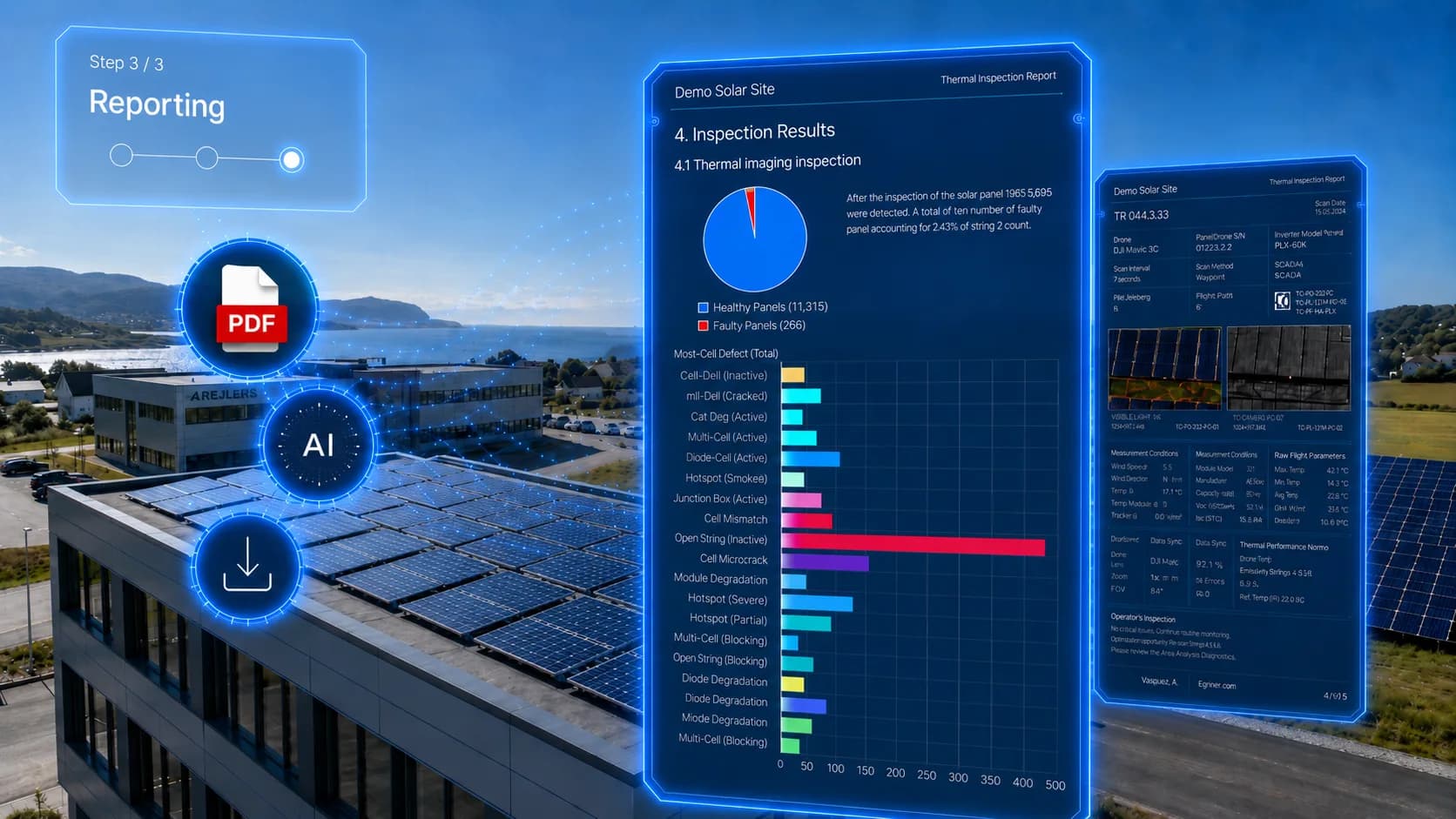
An IEC 62446-3 inspection report documents a thermographic survey of a photovoltaic plant so the results stay comparable between inspectors and over time. It records the inspection scope and conditions, the equipment and its calibration, the personnel and their qualification, and every detected abnormality with its class, its position in the plant and its supporting imagery.
TL;DR
- IEC 62446-3 is the international technical specification for outdoor infrared thermography of photovoltaic modules and plants, published by the IEC in 2017.
- It is not legislation and sets no inspection interval; obligations come from national regulation, workplace safety regimes, insurance schemes or contracts, and they differ by market.
- A standard-aligned report documents scope, conditions, equipment and calibration, personnel, and every abnormality with its class, position and supporting imagery.
- Conformity, compliance and accreditation are three different things: accreditation attaches to an inspection body and its scope, never to software, an algorithm or a report.
- Inspection levels differ in required data quality. MapperX offers 5 cm and 3 cm GSD analysis workflows as product configuration levels, not thresholds set by the specification.
An IEC 62446-3 inspection report is the document that turns a thermal flight into evidence somebody else can rely on. The imagery and the classification work behind it are covered in how AI-assisted thermography detects solar panel faults; this article is about the document itself, what it has to contain, what it proves, and what it does not.
The distinction matters commercially. Buyers frequently ask for an "IEC 62446-3 compliant report" without knowing whether the requirement they are trying to satisfy comes from the specification, from a national rule or from an insurance policy. Those are three different things, and they set different scopes and different expectations about who may perform the work. If you are choosing a provider rather than reading a report, the solar panel inspection software page describes the workflow that produces one.
What Is IEC 62446-3?
IEC 62446-3 is the international technical specification for outdoor infrared thermography of photovoltaic modules and plants, published by the IEC in 2017. It defines the measurement conditions under which a thermographic survey is meaningful, the imaging methodology, the qualification expected of the personnel carrying out the work, and how detected anomalies should be classified and documented.
It sits inside the wider IEC 62446 series. Part 1 covers documentation, commissioning tests and inspection of grid-connected photovoltaic systems, which is the paperwork most plants already produce at handover. Part 3 is the thermography-specific part, and it is the one that governs what a thermal inspection report has to look like.
One wording detail is worth keeping straight. It is published as a Technical Specification, abbreviated TS, rather than as a full International Standard. In practice the industry treats it as the reference for photovoltaic thermography, but the correct written reference is IEC 62446-3. The document is sold by the IEC, so the authoritative wording exists only in the purchased text. Any summary, including this article, is a description of it and not a substitute for it, and it should be checked against the purchased document before it is used contractually.
Is IEC 62446-3 a Legal Requirement?
No. IEC 62446-3 is not legislation, it does not oblige anyone to inspect a plant, and it does not prescribe how often an inspection should happen. It describes how a thermographic inspection should be performed and documented when one is performed. Any statement that a plant "must" be inspected under IEC 62446-3 is, strictly, incorrect: the obligation always comes from somewhere else.
Where an obligation to inspect can come from
- National regulation of electrical installations. Several markets require periodic inspection of installations above a stated capacity, and some reserve that inspection to an accredited control body. Spain's REBT regime, described in the service pages of inspection providers such as TÜV SÜD, works on that model.
- Workplace safety regimes. Periodic testing of electrical equipment and installations at workplaces is organized in Germany under DGUV Vorschrift 3 together with DIN VDE 0105-100, as described in the service pages of providers such as TÜV NORD.
- Insurance policies and inspection schemes. Some markets have a dedicated scheme that insurers reference. In the Netherlands that scheme is SCIOS Scope 12 for photovoltaic installations, described in the service pages of providers such as SOCOTEC.
- Contracts. EPC acceptance conditions, O&M agreements, lender requirements and module or workmanship warranty terms routinely specify an inspection and a report format, independently of any statute.
- Internal O&M standards. An asset manager may set a screening cadence for its own portfolio, which is a policy decision rather than a legal one.
This article deliberately does not restate intervals, capacity thresholds or eligibility rules. They differ by country, they change, and getting one wrong in a scope agreement is expensive. The provider pages cited here are commercial service descriptions rather than primary legal texts, and they are included to show that a regime exists, not to establish its current content. Confirm the requirement that applies to your site with the competent national authority, your insurer or your legal adviser before agreeing a scope, because a report that satisfies an insurer may not satisfy a regime that reserves the inspection to an accredited body.
Compliance, Conformity and Accreditation Are Three Different Things
These three words are used interchangeably in sales material, and the confusion causes real disputes at handover.
Conformity describes the work: the inspection was carried out and documented in the way the specification describes. A report can be conformant with IEC 62446-3 in method and content.
Compliance describes an obligation being met. Whether an inspection satisfies an obligation is decided by the text of that obligation, whether it is a national rule, a policy condition or a contract clause, not by the specification and not by a supplier's assertion.
Accreditation is a formal recognition granted to a legal entity, for a defined scope of activity, by a national accreditation body. It attaches to the inspection body and to that scope. It does not attach to software, to an algorithm, to a file format or to a report.
The practical consequences follow directly. There is no such thing as an "accredited report" or "accredited AI"; there is a report issued by an accredited body within its accredited scope. A vendor can honestly say that its output is structured to the content requirements of IEC 62446-3. It cannot honestly say that buying the software makes an inspection compliant or accredited.
What Must the Report Contain?
An IEC 62446-3 inspection report documents the context of the inspection alongside the findings, so that a third party can judge whether the results are trustworthy. A list of hotspots on an orthophoto is not a report; it is one layer of one.
Plant identification and scope
The report identifies the plant, its location, its capacity and the portion of it that was actually inspected. Partial coverage is legitimate as long as it is stated: an inspection covering three of five blocks is a valid deliverable, and an inspection that silently omits two blocks is not.
Inspection conditions
Environmental conditions at the time of capture decide whether the thermal data means anything. Irradiance, ambient temperature, wind and cloud stability are recorded, along with the operating state of the plant, because load-dependent faults are only visible while the plant is producing. A minimum irradiance is specified, and 600 W/m² is the figure commonly cited from the specification.
Equipment, calibration and personnel
The report states which camera and platform were used, the relevant optical and thermal specifications, and the calibration status of the equipment. It also records who carried out the inspection and their qualification, which is what makes the result attributable rather than anonymous.
Findings, classification and evidence
Every detected abnormality is documented with its position in the plant, the thermal image it was detected in, and the class assigned to it. Supporting RGB imagery belongs with the thermal evidence because it helps distinguish soiling and shading from a possible electrical fault; field validation may still be needed to confirm the cause.
Conclusions, limitations and recommended actions
The closing section states what was found overall, what should be done, and what could not be assessed. Naming the limits is not a weakness in a report; an inspection that omits its own gaps is the one that fails review.
How Does Classification Turn Findings Into Actions?
Classification is the part that turns observation into a decision. A standard-aligned report separates findings that require prompt intervention from those that belong in planned maintenance and those that are recorded for monitoring only, and it attaches a recommended action to each class.
Three inputs drive the class in practice: the pattern type, because a conducting bypass diode and a soiling band are different physical events; the extent of the affected area, because a single cell and a whole string are different losses; and the persistence of the pattern, because an artifact that appears in one frame and not the next is not a fault. Some classes also carry a safety dimension rather than only a yield one, and the failure modes behind them are documented in the IEA PVPS Task 13 review of photovoltaic module failures.
What should not drive the class on its own is a single temperature difference. The same physical fault reads differently depending on irradiance, wind and ambient temperature at the moment of capture, which is exactly why the specification asks for those conditions to be recorded next to the findings.
Which Conditions Make an Inspection Valid?
An inspection is valid when the data behind it could physically carry the conclusions drawn from it. Five conditions decide that, and all five belong in the report rather than in the provider's head.
Irradiance has to be high enough and stable enough for load-dependent faults to appear, with 600 W/m² as the commonly cited working floor. The plant has to be operating under load, because a disconnected string looks healthy in the thermal layer. The thermal imagery has to carry measurable per-pixel temperature values, which rules out screen-color exports. The ground sample distance has to match the requested inspection level. And the camera has to stay close to perpendicular to the module surface, because module glass reflects strongly at shallow angles and produces warm spots that are not there.
When one of these fails, the correct response is a re-flight of the affected area. Reporting a finding derived from data that cannot support it is the failure mode that damages an inspection program's credibility, and it costs far more than a second flight.
What Are the Inspection Levels?
IEC 62446-3 does not treat every thermographic inspection as the same product. It distinguishes inspection levels with different requirements for data quality and reporting depth, which is the origin of the industry shorthand of a screening pass against a detailed inspection. Because the specification is a paid document, the authoritative definitions exist only in the purchased text.
The practical difference is easy to state. A screening campaign answers whether a site has a problem worth investigating and tolerates a coarser ground sample distance. A detailed campaign is what an acceptance test, a warranty claim or a regulated inspection expects, and it is flown at the finer resolution that level requires. In MapperX terms that is the choice between the 5 cm and the 3 cm GSD analysis workflows, which are product configuration levels rather than thresholds set by the specification, and it is the single largest scope decision in a campaign.
The Report Lifecycle: Capture, Review, Approval, Export, Audit Trail
A report is not a file that appears at the end of a flight. It passes through five stages, and a gap in any of them shows up later as a dispute.
Capture produces the thermal and RGB imagery together with the conditions recorded for the flight. Ingest and data-quality review is the gate where a dataset is either accepted or sent back for a re-flight, and the criteria for that decision should be agreed before the campaign, not after it. Analysis and classification assigns each detected pattern to a module position and an abnormality class. Technical review and approval is where a named person with a stated qualification accepts, reclassifies or rejects each finding and signs the document. Export and retention fixes the version: a report carries an issue date, a revision identifier and a record of what superseded it, so that a later revision does not quietly replace an earlier conclusion.
The audit trail is what ties those stages together. A reader should be able to move from a finding in the conclusions back to the thermal frame it came from, and forward to the work order that closed it.
How Does MapperX Produce a Standard-Aligned Report?
MapperX assembles the report from the same chain of evidence that produced the findings, rather than reconstructing it afterwards. As each anomaly is classified through AI-assisted analysis and human review, its source thermal frame, its RGB counterpart, its position in the plant layout and the conditions recorded for the flight stay attached to it, and the document is generated from that structure. Reusing the stored evidence reduces manual re-entry and supports consistency between sites, campaigns and analysts. Results depend on inspection conditions, data acquisition and validation. The MapperX platform page documents the current supported drone models and the flight parameters each analysis level expects.
The boundary is worth stating explicitly rather than leaving it implied. MapperX produces standard-aligned inspection data and documentation. Accredited inspection activities are performed within the accredited scope of the responsible inspection body, and where a national regime reserves an inspection to such a body, that body remains the party performing and issuing the regulated inspection.
What Does the Report Not Prove?
A thermographic report proves that a temperature pattern was observed on a specific module under recorded conditions. It does not prove the electrical root cause behind that pattern. A bypass diode pattern narrows the diagnosis to one substring, but whether the diode failed or a shading condition forced it to conduct is settled by a field check, not by the thermal layer.
This is why a credible inspection program pairs the report with a verification step. Aerial thermography localizes at plant scale; I-V curve tracing, electroluminescence imaging and connector checks confirm at component scale. Treating the report as decision support rather than as a verdict is what keeps classification honest over successive campaigns.
Using a Report With an Insurer, a Warranty Claim or a Buyer
Whether a thermographic report is accepted in an insurance discussion, a warranty claim or a technical due diligence exercise depends on the contract and the jurisdiction, and no report format guarantees an outcome. What you can control is whether the document carries what a counterparty will ask for.
That usually means the scope actually inspected, the conditions during capture, the equipment and its calibration status, the identity and qualification of the person who signed it, a class and a recommended action for every finding, the imagery each finding was derived from, and a stable module reference that lets this campaign be compared with the last one. Ask the receiving party what it requires before the flight rather than after the report is issued, because scope decisions cannot be repaired retrospectively.
How Long Should Reports Be Kept and Compared?
Inspection reports are worth keeping for the operating life of the plant, because their value compounds. A single report describes a moment; a series of reports on the same module map describes a trend, and a trend is what supports a warranty discussion, an insurance conversation or a repowering decision.
That only works if findings are anchored to a stable module identity rather than to image file names, because the next campaign renames every frame. Comparisons are also only meaningful between campaigns flown under broadly similar conditions. How that continuity is built and maintained is the subject of building a digital twin of your solar plant.
A Checklist Before You Accept a Report
- The inspected scope is stated explicitly, including anything not covered.
- Irradiance, ambient conditions and plant operating state are recorded for the capture window.
- Camera, platform and calibration status are named, along with who performed the inspection and under what qualification.
- Every finding carries a module position, a thermal image and a class with a recommended action.
- RGB evidence accompanies findings where soiling, shading or reflection could explain the pattern.
- Re-flight criteria and any data-quality limitations are documented rather than omitted.
- The report carries an issue date and a revision identifier, and findings reference stable module identities.
- The report states which obligation it is meant to satisfy, and it does not describe itself, the software or the algorithm as accredited.
Credit-based MapperX plans price the analysis per campaign, so the reporting depth a site needs can follow its obligation rather than a fixed annual contract.
Key facts
- Standard reference
- IEC 62446-3:2017, outdoor infrared thermography of PV modules and plants[1]
- Legal status
- Technical specification, not legislation; it creates no obligation and prescribes no interval[1]
- Capture conditions
- Plant under load, irradiance commonly cited from about 600 W/m², stable during the flight[1]
- Required report content
- Scope, conditions, equipment and calibration, personnel, classified findings with position and evidence[1]
- Where obligations come from
- National regulation, workplace safety regimes, insurance schemes or contracts; verify locally, not from this article
- Accreditation boundary
- Held by the responsible inspection body for a defined scope; not by software, an algorithm or a document
- Related part
- IEC 62446-1 covers documentation, commissioning tests and inspection of grid-connected PV systems[2]
Screening summary vs. standard-aligned report
| Screening summary | IEC 62446-3 structured report | |
|---|---|---|
| Inspection conditions | Often omitted | Irradiance, ambient conditions and plant load recorded |
| Equipment and personnel | Rarely stated | Camera, calibration status and qualified inspector named |
| Finding classification | Warm areas marked on an image | Each abnormality classed with a recommended action |
| Location of findings | Approximate, image based | Module position in the plant layout |
| Stated limitations | Usually absent | Uninspected areas and data-quality issues documented |
| Comparability over time | Difficult between campaigns | Consistent structure and stable module identity |
From flight to a standard-aligned report
- 01
Confirm the inspection conditions
Check irradiance, stability, wind and plant operating state before takeoff, and record them, because these values decide whether the thermal data can carry any conclusion.
- 02
Capture temperature-embedded thermal and RGB imagery
Fly at the ground sample distance the requested inspection level needs, keeping the camera close to perpendicular and logging positioning for every frame.
- 03
Classify every detected abnormality at module level
Assign each detected pattern to a module position and to an abnormality class, with the RGB counterpart attached to help assess whether soiling or reflections explain the pattern; validate uncertain findings in the field.
- 04
Review, approve and issue the report
A named reviewer with a stated qualification accepts, reclassifies or rejects each finding, and the document is generated from the stored chain of evidence with scope, conditions, equipment, actions and limitations.
Technical details
What the report has to record
| Plant and scope | Site identification, capacity and the portion actually inspected |
|---|---|
| Conditions | Irradiance, ambient temperature, wind, cloud stability, plant operating state |
| Equipment | Camera and platform, optical and thermal specifications, calibration status |
| Personnel | Who performed the inspection and their qualification |
| Findings | Module position, thermal image, RGB counterpart, abnormality class |
| Actions | Recommended action per class and overall conclusions |
| Limitations | Uninspected areas, data-quality issues and re-flight criteria |
| Version | Issue date, revision identifier and what the revision supersedes |
Where an obligation to inspect can come from
| National electrical regulation | May set intervals, capacity thresholds and who may perform the inspection; verify the current national text |
|---|---|
| Workplace safety regime | Periodic testing duties for electrical installations at workplaces, set by the applicable national rule |
| Insurance policy or scheme | Cover conditions may reference a national inspection scheme; the policy defines the scope |
| Contract | EPC acceptance, O&M agreement, lender requirement or warranty terms, independently of any statute |
| Internal O&M standard | A portfolio screening cadence set by the asset manager as a policy decision |
| IEC 62446-3 | Defines the method and the report content; creates no obligation and sets no interval |
IEC 62446-1 and IEC 62446-3 side by side
| Part 1, subject | Documentation, commissioning tests and inspection of grid-connected PV systems |
|---|---|
| Part 1, typical trigger | Handover, commissioning and periodic verification of the installation |
| Part 3, subject | Outdoor infrared thermography of PV modules and plants |
| Part 3, typical trigger | A thermographic survey, whether for screening, acceptance or a claim |
| Overlap | Part 3 output is commonly filed alongside the Part 1 documentation set |
| Neither part | Creates a statutory obligation to inspect or sets a national interval |
Tips and common mistakes

- Tip
Establish which obligation the report has to satisfy before agreeing a scope: a national rule, an insurance condition and an internal O&M standard ask for different things.
- Tip
Record irradiance, wind and plant operating state for every campaign, so later campaigns can be compared against the same baseline conditions.
- Avoid
Treating IEC 62446-3 as a legal obligation with a fixed interval; it is a technical specification and it is neither.
- Avoid
Accepting a report that lists findings without the inspection conditions, the equipment used or the qualification of the inspector.
- Tip
Ask in advance who decides that a re-flight is needed and who pays for it, because unstable irradiance can require a campaign to be repeated.
- Avoid
Accepting "accredited software" or an "accredited report" as an answer; accreditation is held by an inspection body for a defined scope.
- Avoid
Anchoring findings to image file names instead of module identity, which makes the next campaign impossible to compare against this one.
Frequently asked questions
IEC 62446-3 is the international technical specification for outdoor infrared thermography of photovoltaic modules and plants, published by the IEC in 2017. It defines the measurement conditions, the imaging methodology, the qualification expected of personnel and how anomalies should be classified and documented in the inspection report.
The specification itself creates no obligation. Whether an inspection is required, how often, and who may perform it depends on the national regulation, the workplace safety regime, the insurance policy or the contract that applies to your site. Those rules differ by country and change, so confirm the current requirement with the competent authority, your insurer or your legal adviser.
It does not set an interval. Any interval you are subject to comes from a national rule, an insurance condition, a lender requirement or an O&M contract. Asking a provider to name the source of the interval they quote is a fast way to tell a documented obligation from a sales assumption.
Software can assemble the required content and keep the evidence chain intact, which is what MapperX does. It cannot make an inspection compliant, because compliance is decided by the obligation that applies, and accredited inspection activities are performed within the accredited scope of the responsible inspection body.
No. Accreditation is granted to a legal entity for a defined scope of activity by a national accreditation body. A report is issued by an accredited body within its accredited scope; the document itself, the software that produced it and the detection model inside it are not accredited, and any claim to the contrary should be treated as a warning sign.
The plant must be operating under load, irradiance must be sufficient and stable during capture, with about 600 W/m² as the commonly cited working floor, the thermal imagery must carry measurable per-pixel temperatures, the ground sample distance must match the inspection level, and the camera must stay close to perpendicular to the module surface.
No. Part 1 covers documentation, commissioning tests and inspection of grid-connected photovoltaic systems, which is the handover paperwork most plants already produce. Part 3 is the thermography-specific part and governs how a thermal inspection is performed and reported. Neither part creates a statutory duty to inspect.
The two levels differ in required data quality and reporting depth. A screening campaign answers whether a site has a problem worth investigating and tolerates a coarser ground sample distance, while a detailed campaign is flown at finer resolution for acceptance tests, warranty claims and regulated inspections. The authoritative definitions are in the purchased specification.
That depends on the contract and the jurisdiction, and no report format guarantees an outcome. What you can control is whether the document carries the scope, conditions, equipment, qualified signature, classification, evidence and stable module references that a counterparty will ask for. Confirm what the receiving party requires before the flight.
Confirm that the inspected scope is stated including gaps, that capture conditions and plant load are recorded, that camera, calibration and inspector qualification are named, that every finding carries a module position and an abnormality class, that limitations and re-flight criteria are documented, and that the report carries an issue date and a revision identifier.
Glossary
The international technical specification for outdoor infrared thermography of photovoltaic modules and plants. It defines measurement conditions, methodology, personnel qualification and anomaly classification.
An IEC deliverable published where a subject is still developing or full consensus for an International Standard is not yet available. It is a normative reference document, not legislation.
A statement that work was carried out and documented in the way a specification describes. It says nothing about whether a legal or contractual obligation has been satisfied.
Satisfaction of an obligation set by law, by an insurance policy or by a contract. It is decided by the text of that obligation, not by the specification a report follows.
Formal recognition granted to a legal entity, for a defined scope of activity, by a national accreditation body. It attaches to the inspection body and its scope, never to software, an algorithm or a document.
The severity category assigned to a detected thermal anomaly in a standard-aligned report. It determines whether a finding needs prompt intervention, planned maintenance or monitoring only.
A Dutch inspection scheme for photovoltaic installations, referenced in the service descriptions of inspection providers. Its current scope and conditions are defined by the scheme owner, not by IEC 62446-3.
The German accident-prevention rule for electrical installations and equipment at workplaces, applied together with DIN VDE 0105-100. Its scope and testing duties are set by the applicable national text.
An accredited control body authorized to carry out regulated electrical inspections in Spain. Which installations fall into that channel is defined by the applicable Spanish regulation.
The solar power arriving per unit area, measured in watts per square meter. Thermographic inspection needs it high and stable, commonly cited from about 600 W/m², so load-dependent faults become visible.
The record that lets a reader move from a conclusion back to the thermal frame it was derived from, and forward to the work order that closed it, including report revisions.
Sources and standards
- IEC 62446-3:2017, Photovoltaic (PV) systems: Requirements for testing, documentation and maintenance, Part 3: Outdoor infrared thermography
- IEC 62446-1: Grid connected systems, documentation, commissioning tests and inspection
- IEA PVPS Task 13: Review of Failures of Photovoltaic Modules
- SOCOTEC Netherlands, commercial service description: SCIOS Scope 12 inspection of photovoltaic installations (not a primary legal text)
- TÜV NORD, commercial service description: testing of electrical installations under VdS and DGUV Vorschrift 3 (not a primary legal text)
- TÜV SÜD España, commercial service description: periodic REBT inspection of photovoltaic installations by an accredited OCA (not a primary legal text)
- MapperX knowledge base (first-party product documentation): analysis levels, flight parameters and report output
Conclusion
IEC 62446-3 is the international technical specification, published in 2017, for outdoor infrared thermography of photovoltaic modules and plants. It defines valid measurement conditions, imaging methodology, personnel qualification and anomaly classification, and it requires an inspection report to document scope, environmental conditions, equipment and calibration, personnel, and every abnormality with its class, its position in the plant and its supporting imagery. It is not legislation and sets no inspection interval: an obligation to inspect comes from national regulation of electrical installations, a workplace safety regime, an insurance policy or scheme, or a contract, and those rules differ by market and change over time, so they must be verified with the competent authority rather than taken from an article. Conformity, compliance and accreditation are distinct: accreditation is granted to a legal entity for a defined scope by a national accreditation body and never attaches to software, an algorithm or a report. MapperX assembles standard-aligned inspection data and reports from the stored evidence chain, while accredited inspection activities remain within the accredited scope of the responsible inspection body.