
Open Circuit Voltage Test (Voc)
An open-circuit voltage (Voc) test measures PV module or string voltage when no load current is drawn. Learn why it is done, how to read results and its limits.
What the Voc Test Measures
Open-circuit voltage, commonly written as Voc, is the voltage measured across a PV module, string, or array circuit when no operating current is being drawn from that source. The circuit remains energized by sunlight, but the measurement is taken in an open-circuit condition rather than while the source is supplying load current.
For a PV string, the measured Voc reflects the combined voltage contribution of the modules connected in series. This makes the test useful for checking whether the electrical configuration behaves consistently with the expected number and type of modules.
Voc is strongly affected by module temperature and is also influenced by irradiance. The value should therefore be interpreted against the conditions present during measurement and the electrical characteristics of the installed modules.
A voltage reading is evidence about one electrical parameter. It does not provide a complete assessment of module power, string current, insulation condition, connector resistance, or performance under load.
Why It Is Performed
One common use of Voc measurement is to verify string configuration. If a string is expected to contain a defined number of series-connected modules, its open-circuit voltage can be compared with the expected value calculated from the module characteristics and actual measurement conditions.
A substantial difference can justify investigation of missing modules, incorrect wiring, open circuits, reversed sections, unexpected connections, or another configuration problem. The measurement can also help distinguish between strings when labels or documentation require verification in the field.
During troubleshooting, Voc can be measured at progressively smaller sections of a circuit where the installation permits safe isolation. This can help determine whether an abnormal voltage originates in a complete string, part of a string, or an individual module.
The test can also support verification after module replacement or electrical work. A measured result consistent with the intended configuration provides evidence that the tested circuit is connected as expected, although it does not prove that every component performs correctly under load.
Voc testing is therefore most useful when the expected result is known. A voltage number without a reference configuration or environmental context is difficult to interpret reliably.
Why It Matters for Condition Assessment
Series-connected PV modules contribute voltage to the string, so an unexpected Voc value can indicate that the electrical configuration does not match the design or that part of the series path requires investigation. This makes voltage testing useful during commissioning and fault isolation.
Comparing similar strings can also reveal differences that deserve follow-up. If several strings use the same module type, series count, orientation, and measurement conditions, their open-circuit voltages would normally be expected to follow a comparable pattern. A material difference may indicate a wiring, module, or measurement issue.
Condition assessment should not stop at the voltage reading. Some defects have limited effect on Voc while significantly affecting current or power under load. A string can therefore show an apparently reasonable open-circuit voltage and still contain damaged cells, contamination, shading, high-resistance connections, insulation defects, or bypass-related conditions.
For this reason, Voc should be combined with other evidence where the inspection question requires it. Short-circuit current, operating measurements, insulation resistance, visual inspection, thermography, monitoring data, or module-level tests may provide information that Voc cannot.
The test contributes to verification by confirming electrical conditions. It should not be presented as a method that directly increases plant efficiency.
How the Measurement Is Taken Safely
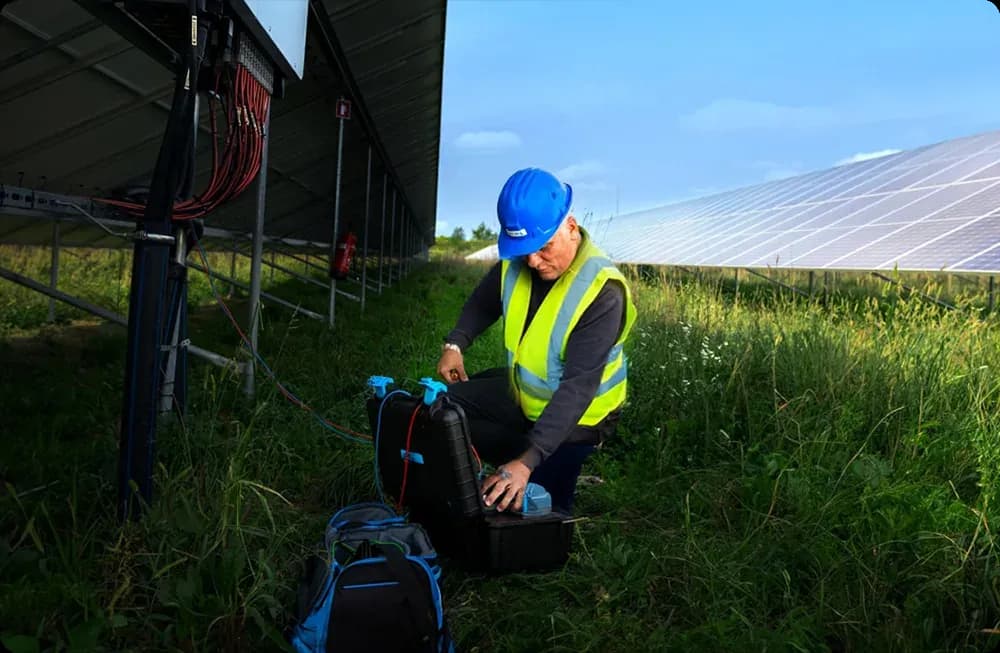
Although no load current is intentionally flowing during a Voc measurement, the circuit can still be at hazardous DC voltage. PV strings can remain energized whenever sufficient irradiance is available, and the absence of current does not make exposed conductors safe to touch.
The field team should identify the circuit, expected voltage range, system configuration, and suitable measurement points before connecting a meter. The instrument, leads, probes, connectors, and working procedure should be rated for the expected DC voltage and electrical environment.
The measurement should be taken across the defined positive and negative terminals without creating an unintended short circuit. Personnel should avoid disturbing connectors or terminals unless the circuit has been placed into the state required by the site's isolation procedure.
Where circuit disconnection is required to establish an open-circuit condition, the switching sequence should follow the equipment design and approved procedure. DC connectors that are not designed for load breaking should not be separated while carrying current.
Environmental conditions should be recorded close to the time of measurement. Module temperature is particularly important because PV voltage changes with temperature, and rapidly changing irradiance can also affect the observed value.
Competent personnel should perform the work because interpretation and electrical safety both depend on understanding the circuit arrangement.
Interpreting Results
The expected Voc should be based on the module electrical characteristics, number of series-connected modules, and actual or estimated module temperature. Module voltage generally changes with temperature according to the temperature coefficient provided for the product, so a cold array can show a different Voc from the same array under hot operating conditions.
Irradiance also affects open-circuit voltage, although the relationship differs from its stronger influence on current. Very low or rapidly changing irradiance can make comparisons less reliable, particularly if measurements of different strings are taken at different times.
A measured string voltage should therefore not be compared blindly with a single nominal design value. The field team should establish what range or expected result is appropriate for the conditions and equipment being tested.
A lower-than-expected voltage may justify investigation of string configuration, module connections, damaged conductors, open sections, or other electrical conditions. An unusual reading should first be verified with the correct meter range, polarity, connection points, and circuit state before a component fault is declared.
A normal Voc result does not prove that the string delivers expected power. Open-circuit measurement does not test behavior at the maximum power point or under inverter load.
Records and Frequency
The test record should identify the module, string, or circuit measured, its design configuration, measured Voc, date and time, instrument, polarity, and relevant environmental conditions. Recording module temperature or the temperature basis used for comparison makes later review more meaningful.
Where the result is compared with an expected value, the record should state how that expectation was established. This could include module information, string series count, design documentation, or another defined comparison method.
Voc measurements may be performed during commissioning, after module or string work, during fault finding, or as part of an established electrical inspection program. They can also be triggered by monitoring information suggesting that a string or inverter input is behaving differently from comparable circuits.
No universal interval fits every installation. The need for repeat testing depends on maintenance strategy, plant history, equipment changes, observed abnormalities, and other inspection requirements.
If a circuit cannot be measured safely or access is unavailable, that limitation should be documented. An untested string should not be assumed to have passed.
Limits of the Test
Voc testing does not measure power output under load. It cannot establish inverter efficiency, string current capability, maximum-power-point behavior, insulation resistance, or the quality of every electrical connection.
A string with a normal open-circuit voltage may still contain faults. High-resistance connectors, contamination, partial shading, thermal abnormalities, current mismatch, insulation problems, or intermittent defects may not produce a clear Voc deviation.
One reading should therefore not be used as a complete diagnosis. Unexpected voltage should lead to additional inspection or measurements selected according to the suspected condition.
Thermography can provide different evidence, but a thermal image alone cannot prove the electrical configuration of a string. IEC 62446-3 covers outdoor thermographic inspection of operating PV systems, including equipment, environmental conditions, inspection procedure, personnel competence, and reporting. It does not define the Voc measurement method or impose a universal temperature range on PV plants.
A satisfactory Voc measurement also does not prove overall plant safety. Other electrical and mechanical checks remain necessary where the inspection scope requires them.