
PV Current Test (Short Circuit)
A short-circuit current (Isc) test measures PV current at approximately zero terminal voltage under the test conditions.
What the Short-Circuit Current Test Measures
A PV short-circuit current test measures the current that a module, string, or array circuit can deliver when the test method intentionally places the source into a short-circuit measurement condition. The result is commonly associated with the current parameter identified as short-circuit current, or Isc. It provides information about the electrical behavior of the tested PV source under the conditions present at the time of measurement.
The value is strongly influenced by solar irradiance. A string measured under high irradiance will normally produce a different short-circuit current from the same string measured under lower irradiance. Temperature, shading, module condition, orientation, contamination, and measurement method can also affect the result.
For this reason, the test should not be interpreted as a fixed health score. Its main value comes from comparing the measured result with an expected value, a design reference, or other electrically comparable strings measured under sufficiently similar conditions.
The measurement also does not describe every aspect of module or string performance. It provides one electrical parameter, not a complete characterization of the PV circuit.
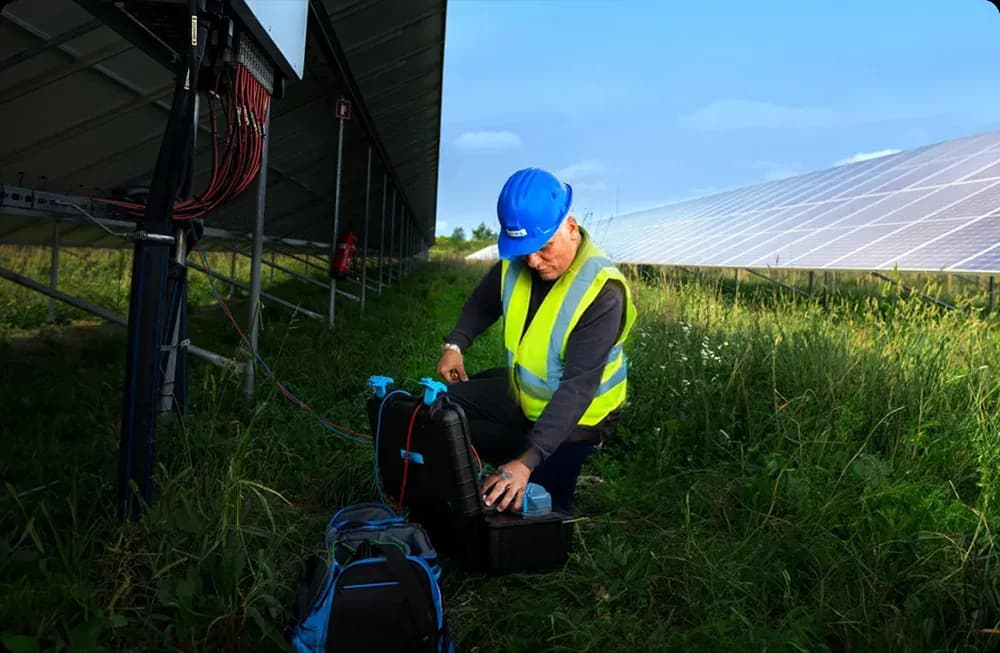
Why It Is Performed
One reason to measure short-circuit current is to compare similar strings within the same array. If strings have the same module type, number of modules, orientation, irradiance, and general operating conditions, a significant difference between their measured current values may indicate that one string needs further investigation.
The test can also be used to compare a measured value with an expected value derived from design information or the measured environmental conditions. A lower or higher result than expected does not automatically identify the cause, but it can show that the tested circuit is not behaving as anticipated.
During commissioning or troubleshooting, the measurement can help verify that strings are electrically present and capable of producing current. It may assist in finding open circuits, disconnected strings, major shading, wiring errors, or other conditions that produce an obvious difference from comparable circuits.
The test should be used as evidence rather than as a final diagnosis. A current deviation tells the field team where to look next. It does not, on its own, prove whether the cause is a damaged module, a connection problem, contamination, shading, measurement error, or another condition.
Why It Matters for Condition Assessment
PV strings are repeated electrical units, so comparison between similar strings can be useful during condition assessment. When several neighboring strings operate under similar irradiance and geometry, their current behavior provides a reference against which an unusual string can be identified. This can narrow the area that requires inspection.
Short-circuit current testing can therefore complement visual inspection, thermography, string monitoring, and other electrical measurements. A string that shows an abnormal current value may also show visible damage, thermal anomalies, connector problems, or another measurable condition. Combining evidence produces a stronger assessment than relying on one measurement.
The test should not be presented as a way to increase efficiency by itself. Measuring current does not improve module conversion efficiency or restore lost production. It provides information that may support maintenance decisions if a deviation is found.
It also does not prove the absence of degradation. Some module or circuit problems may have little effect on short-circuit current while affecting voltage, insulation, resistance, or power under load. Condition assessment therefore requires the correct test for the question being investigated.
How the Test Is Carried Out Safely
Short-circuit current measurement requires particular care because PV sources can remain energized whenever sufficient light is present. Direct-current circuits can sustain arcs, and opening a connection under load can create a hazardous condition. The test procedure should therefore define how the circuit will be isolated, connected, measured, and restored without creating an unintended load-breaking operation.
The measuring device must be suitable for the expected DC current, voltage, measurement category, and circuit conditions. Depending on the test method and installation design, a suitable current-measuring instrument or clamp meter may be used where the circuit arrangement allows the required measurement without unsafe disconnection. The method should follow the equipment instructions and the site's electrical safety procedure.
Connectors or fuse carriers that are not designed for load interruption should not be opened while carrying current. If a direct short-circuit measurement requires circuit reconfiguration, the string should be placed into the appropriate safe state before connections are changed. The exact sequence depends on the plant design and test method.
Environmental conditions should also be recorded. Irradiance can change significantly during a sequence of measurements, particularly when clouds are moving across the site. Comparing strings measured under different solar conditions without accounting for that difference can produce a false indication of abnormal behavior.
Competent personnel should perform the test because both electrical risk and measurement interpretation depend on the circuit configuration.
Interpreting Results
Short-circuit current is not independent of irradiance. If one string is measured in full sun and another under reduced irradiance, the values should not be compared as though the electrical conditions were identical. Irradiance should therefore be measured or otherwise considered when results are assessed.
Temperature also has an effect, although its influence on current differs from its influence on voltage. Module technology and the manufacturer's electrical characteristics determine how environmental conditions affect the expected value. The interpretation should therefore be based on the actual equipment and measurement context rather than on a universal correction rule.
Comparisons are most useful when strings are electrically and physically comparable. Different orientations, shading patterns, string lengths, module types, or tracker positions can legitimately produce different current values. A deviation should first be checked against these differences before it is classified as a possible fault.
A low result may justify checking for shading, contamination, open connections, module damage, connector problems, string configuration, or measurement error. A normal result does not prove that all modules are fault-free.
The short-circuit current test is therefore one diagnostic input. Root cause normally requires additional evidence.
Records and Frequency
A useful test record identifies the circuit measured, the date and time, the instrument used, the measured current, and the environmental conditions relevant to interpretation. Irradiance should be recorded where it is part of the assessment method. Module or ambient temperature may also be useful depending on how the expected result is being evaluated.
The record should also identify the comparison basis. That may be another string, design documentation, manufacturer information, or a calculated expected value. Without that reference, a current measurement can be difficult to interpret later.
There is no single inspection frequency that fits every PV plant. Short-circuit current testing may be performed during commissioning, after electrical work, during troubleshooting, after an abnormal monitoring result, or as part of a defined periodic inspection program. The interval should follow the plant's maintenance strategy, contractual requirements, and observed condition rather than an arbitrary universal schedule.
Repeated tests are most useful when the method and conditions are recorded consistently. A historical series of values without comparable irradiance or circuit identification can create more confusion than evidence.
Any untested or inaccessible circuits should be recorded as limitations.
Limits of the Test
A short-circuit current result describes one electrical characteristic under one set of conditions. It does not measure maximum power, inverter efficiency, insulation resistance, connection resistance, or the complete electrical safety of the string. Other tests are required when those questions need to be answered.
The measurement also cannot identify every failure mode. A string may produce a plausible short-circuit current while still containing a high-resistance connection, insulation problem, intermittent connector fault, bypass-diode issue, or module defect that appears only under another operating state.
A single abnormal result should not be converted directly into a component diagnosis. The cause may be environmental, electrical, mechanical, or procedural. Verification with additional measurements, inspection, plant monitoring data, or thermography may be necessary.
Thermal inspection can add evidence, but a thermal image alone does not confirm root cause either. IEC 62446-3 concerns outdoor thermographic inspection of operating PV systems, including equipment, environmental conditions, procedure, personnel competence, and reporting; it does not define the procedure for measuring short-circuit current and does not impose one temperature range on all plants.