
Thermal Camera Drone Features
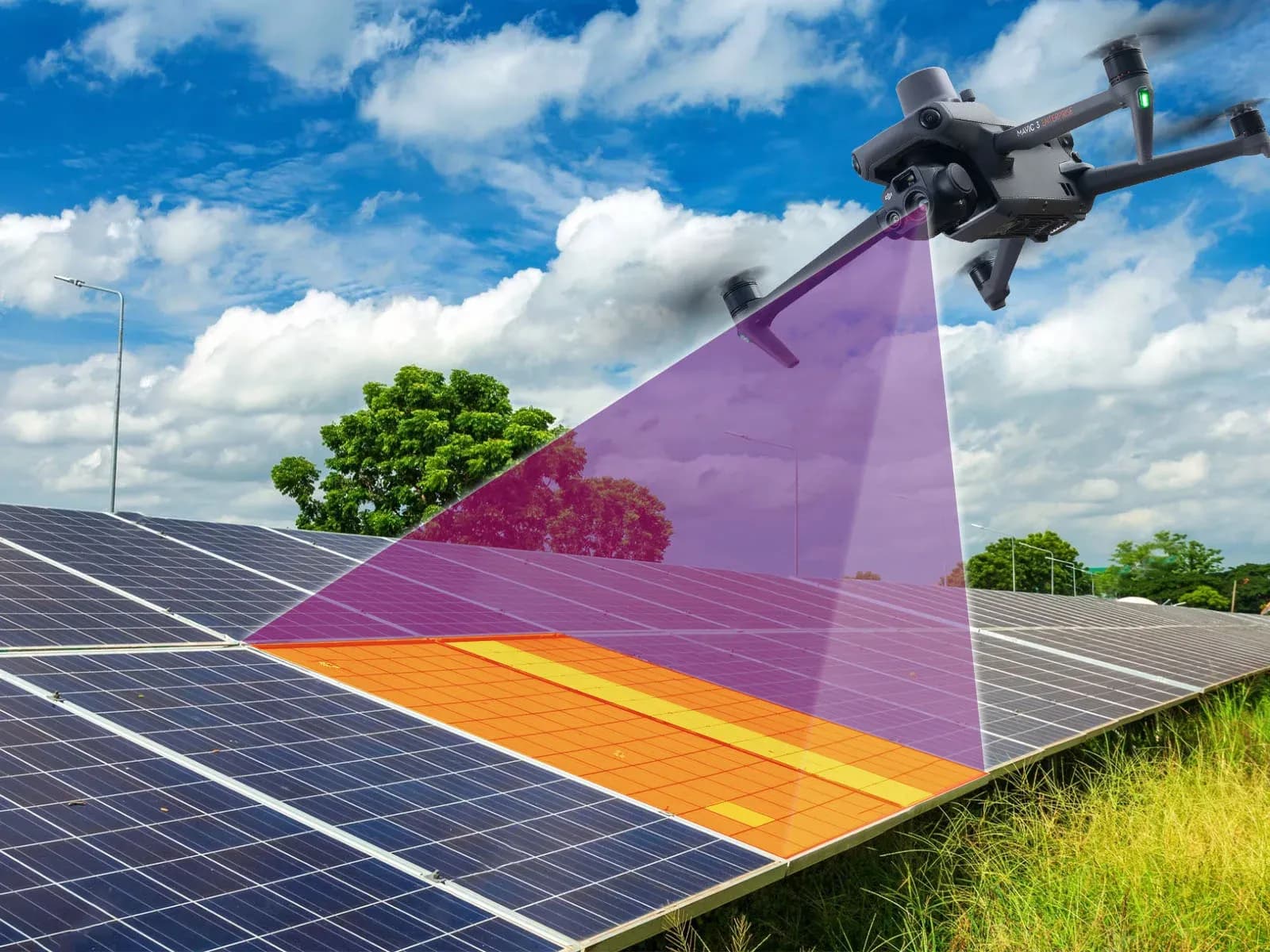
Thermal camera drone features that matter for solar inspection: sensor resolution, temperature measurement, flight time, positioning and field operation.
Thermal Resolution and What It Means on a Module
Thermal resolution determines how many detector elements are available to represent the scene. For PV inspection, that matters because each module, cell group, connector, or other target must occupy enough image area to show the thermal pattern being investigated.
A sensor with more thermal pixels can represent smaller features from the same distance when other optical conditions are comparable. That does not automatically mean that every temperature value in the image is more accurate. Spatial detail and temperature measurement accuracy are different characteristics.
Flight height directly affects how many pixels represent a module. As the aircraft moves higher, each detector element covers a larger physical area, so cell-level detail can disappear even though complete modules remain visible. The correct height should therefore follow the inspection target.
Resolution should also be considered with the lens. Two cameras with the same detector resolution can produce different target detail if their fields of view differ. Camera specification should be evaluated as part of the complete optical system rather than as one isolated number.
For an inspection team, the useful question is not whether a camera has "high resolution" in marketing terms. It is whether the proposed camera, lens, and flight geometry resolve the module feature that the inspection procedure requires.
Temperature Measurement vs Image Quality
Image quality and temperature measurement should not be treated as the same property. A thermal image can appear sharp while still containing measurement uncertainty, and a camera with strong temperature measurement specifications can still produce insufficient spatial detail if the target is too small in the image.
NETD describes thermal sensitivity: the ability of the detector to distinguish small temperature differences under specified conditions. A lower NETD can help reveal subtle thermal contrast, but it does not state the absolute accuracy of every reported temperature.
Temperature measurement accuracy is a separate specification. It describes how closely the camera's reported value corresponds to the target temperature under defined conditions. Emissivity, reflected temperature, distance, atmosphere, viewing angle, calibration, and target properties can all affect field measurement.
Spatial resolution is different again. It describes how finely the scene is sampled. Increasing pixel count may improve the ability to distinguish neighboring cells or small components, but it does not automatically improve the calibration of the reported temperature.
These distinctions matter in PV inspection because a suspected hotspot has both a spatial and thermal dimension. The inspector needs enough detail to know where the pattern occurs and enough measurement quality to interpret the thermal difference within the procedure being used.
Datasheets should therefore be read as a set of separate characteristics rather than reduced to one "accuracy" number.
Optics, Altitude and Ground Sampling Distance
The lens determines how much of the scene reaches the thermal detector and how large a target appears in the image. A wider field of view captures more area but can represent each module with fewer pixels at the same distance. A narrower field can provide more target detail while reducing coverage.
Altitude changes the same relationship. Higher flight can increase area coverage, but each pixel corresponds to a larger area on the ground or module surface. Lower flight increases target detail but may require more flight lines, more images, and more time.
Ground sampling distance is one way to describe the physical area represented by each image pixel. For inclined PV modules, however, camera angle and module geometry also affect effective target resolution. A simple vertical ground calculation may not fully describe how many pixels cover an angled cell surface.
The inspection target should therefore be defined first. Module-level screening can tolerate different resolution from cell-level analysis, and connector inspection may require a different geometry again.
Viewing angle also affects reflections. PV glass can reflect the sky or surrounding objects, creating apparent hot or cool areas. Choosing optics and route geometry is therefore about both resolution and the quality of the thermal observation.
Flight planning should connect lens, altitude, speed, target size, and viewing angle rather than optimizing any one parameter in isolation.
Flight Endurance, Route Repeatability and Data Volume
Flight endurance influences how much of a site can be covered before the aircraft needs a battery change or return to the launch point. On large plants, greater practical endurance can reduce interruptions, but it does not make the thermal data more reliable by itself.
The route must still maintain the required resolution and viewing geometry. Extending flight time has limited value if the aircraft is flown too high or too quickly to resolve the target features. Inspection quality should determine the route, with endurance used to support that route.
Repeatability becomes important when a plant is inspected more than once. Stable route planning, recorded altitude, camera angle, direction, and location references can make later surveys easier to compare. Environmental conditions still need to be considered because repeating the flight path does not recreate the same irradiance, wind, cloud, or module temperature.
Data volume is another operational factor. Higher image density, frequent captures, thermal and visible pairs, and lower flight altitude can create large datasets that require storage, processing, mapping, and human review.
More data is useful only when it improves coverage or evidence. An inspection system should avoid collecting redundant images that increase review workload without adding meaningful information.
A practical drone platform therefore needs enough endurance and route control to support the chosen inspection method, not simply the longest advertised flight time.
Visible Camera: Context, Not Replacement
A visible camera provides context that thermal imagery cannot always supply. It can show broken glass, contamination, vegetation, shadows, mounting condition, labels, module position, or other physical features that help explain a thermal observation.
Visible imagery is also useful for locating findings. Module rows can look similar in thermal images, while higher-detail visible photographs may make it easier to identify the exact frame, row, junction box, or surrounding object associated with the observation.
The visible camera does not replace thermal measurement when the inspection question concerns temperature behavior. A normal photograph cannot show whether one cell area is operating warmer than comparable cells under appropriate conditions.
Thermal imagery likewise does not replace visible inspection. A thermal pattern may be difficult to interpret without knowing whether a leaf, dirt patch, shadow, broken surface, or reflective object is present in the same location.
Neither camera replaces electrical testing. Polarity, insulation resistance, current, voltage, continuity, and other electrical properties require the appropriate measurement procedure when they matter to the maintenance decision.
The two cameras are therefore best used as complementary evidence sources. Their value comes from giving the reviewer different information about the same physical location.
Datasheets vs Datasets
A camera datasheet describes performance under specified test conditions. It can provide thermal resolution, lens options, NETD, temperature measurement accuracy, operating range, frame rate, and other characteristics useful for comparing equipment.
Those specifications do not show how the camera performs on the actual PV target at the planned altitude and route. Real inspection data can reveal whether cells are resolved, whether reflections are manageable, whether focus is stable, and whether temperature contrast remains interpretable in field conditions.
For that reason, equipment evaluation should include representative datasets where possible. Sample thermal images should come from targets and flight geometry similar to the intended inspection rather than from unrelated demonstrations with large, high-contrast objects.
The dataset should also include enough context to judge the conditions. Irradiance, wind, module temperature, flight height, lens, viewing angle, and visible imagery can help determine whether an impressive thermogram reflects the camera's practical usefulness or simply favorable circumstances.
Reviewers should examine difficult cases as well as clean examples. Low contrast, reflective modules, changing clouds, subtle cell patterns, and dense arrays reveal limitations that may not appear in selected promotional images.
Actual datasets do not make the specification sheet irrelevant. They test whether the published characteristics translate into useful evidence for the intended inspection workflow.
Limits and Selection Advice
No single camera or drone specification proves diagnostic superiority. Higher thermal resolution can improve spatial detail, lower NETD can improve sensitivity to small temperature differences, and stronger flight endurance can improve coverage, but none of these characteristics independently establishes that a suspected PV fault will be identified correctly.
Thermal interpretation depends on the complete system: detector, optics, flight geometry, environmental conditions, target size, calibration, acquisition procedure, and reviewer competence. A weak link in one part of that process can limit the value of strong specifications elsewhere.
IEC 62446-3 addresses outdoor thermographic inspection of operating PV systems, including equipment, environmental conditions, procedure, personnel competence, and reporting. It does not specify one universally superior drone or camera and does not impose one temperature range for every PV installation.
Thermal imagery also does not establish root cause by itself. A candidate hotspot, module pattern, or connector temperature difference may require electrical measurement or physical inspection before the condition is confirmed.
AI-assisted review should be treated in the same way. Software can flag candidate findings across a large dataset, but human review remains necessary to separate real observations from reflections, acquisition artifacts, normal operating differences, and other false candidates.
The equipment should therefore be selected against a defined inspection requirement and tested with representative data. The strongest specification is the one that supports the required evidence under the site's actual operating conditions, not the one with the largest number in a single datasheet field.