
Importance and Frequency of Drone Inspections for PV Power Plants
Importance and frequency of drone inspections for PV power plants: why regular inspection matters and what drones add compared with walking the array.
Why Regular Inspection Matters
PV plants contain large numbers of modules, connectors, cables, protective devices, structures, and electrical interfaces operating outdoors over long periods. Weather, contamination, vegetation, mechanical movement, maintenance activity, and electrical loading can change equipment condition after commissioning.
Regular inspection provides opportunities to identify changes before they remain unnoticed for extended periods. The appropriate method depends on the condition being investigated: visible inspection can identify surface and structural issues, thermography can reveal temperature patterns, and electrical tests can verify specific circuit properties.
A scheduled inspection also creates a record of plant condition at a known date. When findings are documented by location and supported by operating conditions, later teams can compare whether a previously observed issue remained stable, was repaired, or changed.
Regular does not mean universal. The useful interval depends on the site, monitoring capability, operating history, environmental exposure, contractual requirements, and consequences of delayed detection. One calendar rule should not be copied across unrelated plants.
What Drone Inspection Adds Compared with Walking the Array
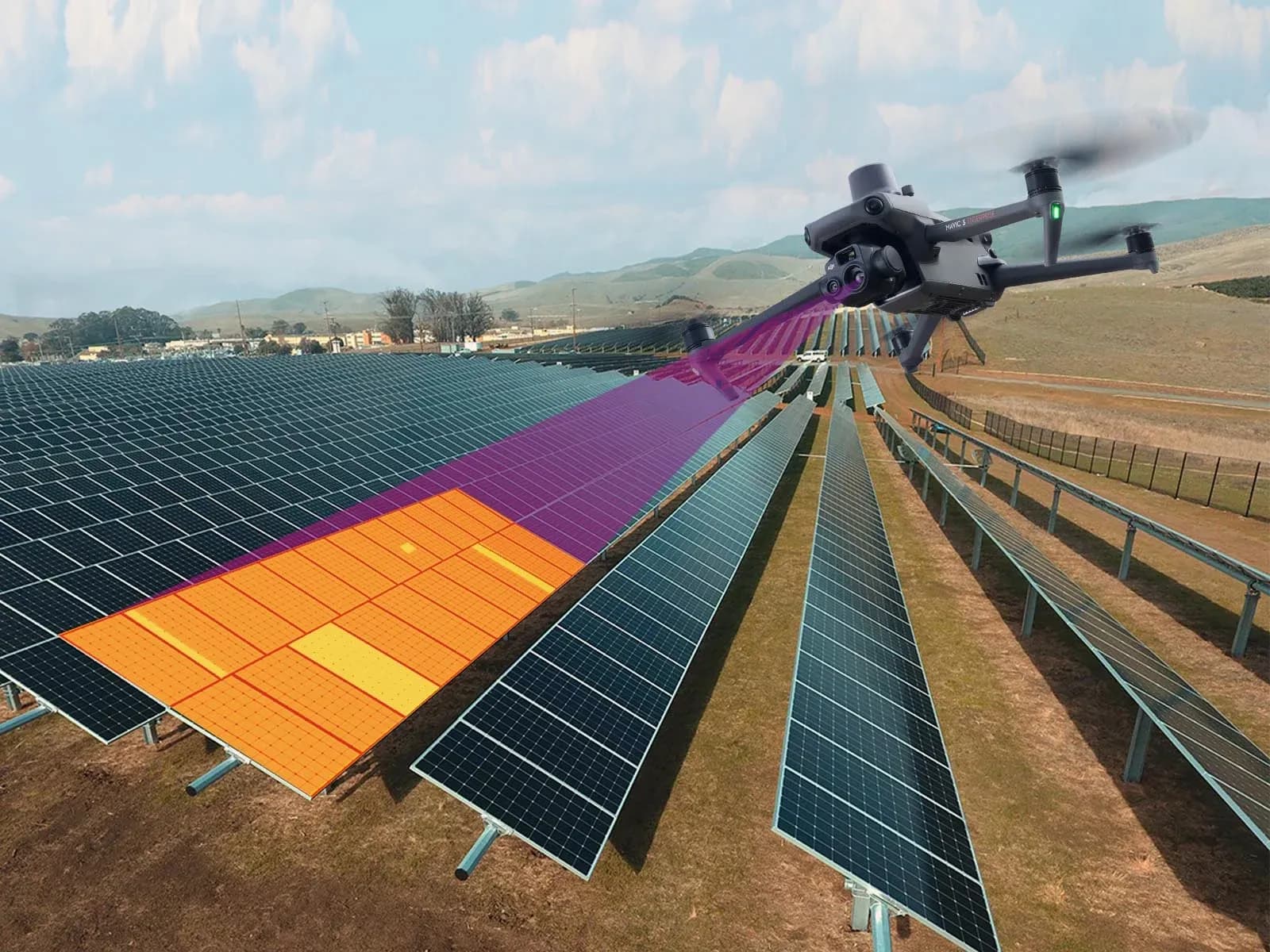
Walking inspections allow technicians to examine equipment closely, but large PV plants can require considerable time to cover row by row. A drone can screen broad areas first and direct ground personnel toward specific modules or sections that require closer examination.
Aerial visible imagery can document broken glass, contamination, vegetation, shading, displaced components, and other surface conditions. Aerial thermography can add temperature-related evidence from operating modules, strings, connectors, or other components when acquisition conditions are suitable.
The advantage is primarily coverage and localization. A drone can create a plant-wide overview while preserving the position of findings, reducing the need to begin every inspection with a detailed manual check of every row.
Ground inspection still remains necessary for many findings. Electrical measurements, connector examination, torque-related checks, component replacement, and close mechanical inspection cannot be completed from the air.
A drone also does not eliminate every safety concern. Flight operations introduce their own site, weather, aviation, and access requirements, while technicians still need safe procedures when entering energized plant areas for follow-up work.
Performance Checks at Commissioning
Commissioning includes measurements and functional checks that establish whether installed equipment behaves according to the design and acceptance criteria. These activities are different from aerial thermographic inspection and should not be replaced by a thermal flight.
Electrical commissioning can include voltage, current, polarity, insulation, protective conductor continuity, functional behavior, protection checks, and other measurements required by the project scope. Production or performance assessment also requires appropriate operating data and measurement conditions rather than an assumption based on thermal appearance.
Thermography can contribute additional information by identifying abnormal surface-temperature patterns while the plant is operating. It may highlight modules, strings, connectors, or electrical areas that deserve further investigation. It does not directly measure every commissioning parameter.
A plant can have acceptable thermal images while still containing configuration, insulation, monitoring, protection, or functional problems. Likewise, an electrical commissioning test can pass while a later thermal survey identifies a localized operating condition that was not visible in the original measurement.
The two approaches should therefore be treated as complementary. Commissioning verifies defined electrical and functional requirements, while thermographic inspection examines temperature behavior under suitable operating conditions.
What Determines the Inspection Interval
Plant size is one factor because larger sites contain more equipment and can make manual condition screening more difficult. This does not automatically mean that every large plant needs more frequent flights, but it can increase the practical value of structured aerial inspection.
Monitoring data is another important input. Where string-level or inverter-level monitoring is available, production deviations and alarms can trigger targeted inspection between planned surveys. A plant with limited monitoring may rely more heavily on scheduled field inspection to discover changes.
Environmental conditions can move the interval in either direction. Sites exposed to hail, dust, vegetation growth, storms, flooding, agricultural activity, or other recurring conditions may need inspection patterns different from sites with more stable surroundings.
Contracts, warranties, insurance conditions, owner procedures, and maintenance agreements can also define inspection or documentation requirements. Those obligations should be read from the actual documents rather than inferred from a generic interval.
Plant history matters as well. Repeated connector issues, recurring vegetation, known drainage problems, or previous storm damage may justify different inspection priorities from a site without the same history.
The interval should therefore be based on evidence and operational requirements rather than on a single fixed number.
Events That Trigger an Extra Survey
Some inspections should be triggered by events rather than waiting for the next planned date. Hail can justify a targeted survey for visible module damage and thermal abnormalities, particularly when the affected area is large or difficult to assess from the ground.
Severe storms can create similar reasons for review. Wind, debris, water, or structural movement may affect modules, mounting, cabling, or site access. The inspection scope should be based on the actual event rather than assuming that one flight can identify every possible consequence.
A fire or electrical incident can also justify aerial inspection after the area has been made suitable for assessment. Thermal and visible imagery may help document affected sections, but electrical safety and root-cause investigation require appropriate ground procedures and measurements.
Nearby construction can introduce dust, shading, debris, access changes, or accidental physical interference. Where those conditions plausibly affect the plant, an additional survey may be useful.
Production deviations are another trigger. If monitoring shows one block, inverter input, or string behaving differently from comparable equipment, a targeted drone survey can help determine whether visible or thermal evidence exists in the same location.
An extra flight should always have a defined question. Event-driven inspection is most useful when the team knows what evidence it needs and what follow-up will occur if an abnormality is found.
Records That Make Repeat Inspections Useful
Repeat inspection only becomes meaningful when the earlier survey contains enough context for comparison. At minimum, the record should include the inspection date and time, the plant area covered, and the modules or regions that could not be inspected reliably.
For thermographic work, irradiance should be recorded because it influences module loading and thermal contrast. Module temperature, wind, and cloud conditions also matter because they can change the apparent temperature pattern independently of equipment condition.
Flight parameters should be preserved where they affect comparability. Altitude, camera configuration, viewing geometry, route, and other relevant acquisition details can determine whether a later image represents the same target with similar resolution.
Location is equally important. A thermal finding should be associated with a row, module, string, block, or other field reference that can be found again. A large archive of images without reliable physical identification has limited maintenance value.
IEC 62446-3 addresses outdoor thermographic inspection of operating PV systems, including equipment, environmental conditions, procedure, personnel competence, and reporting. It does not prescribe one universal temperature range or one universal inspection interval for every PV plant.
Good records allow later reviewers to distinguish a genuine equipment change from a difference caused by weather or acquisition method.
Limits
There is no single drone-inspection frequency that fits every PV plant. The interval should reflect monitoring coverage, plant size, environmental exposure, operating history, contractual requirements, and the consequences of missing a developing condition.
A single survey is not continuous monitoring. A component may develop a problem after the flight, and an intermittent defect may not be active during the inspection. Monitoring data and event-driven checks remain important between planned surveys.
Thermal imagery also cannot prove root cause on its own. A hotspot, cell-level temperature difference, connector heating pattern, or unusual string appearance can justify further investigation, but electrical confirmation or physical inspection may still be required.
Drone imagery cannot replace measurements for insulation resistance, polarity, current, voltage, continuity, protective functions, or other electrical properties. Software that organizes aerial findings likewise does not replace those tests.
The useful inspection schedule is therefore one that can be explained from plant evidence and revised when conditions change. Drone surveys form one part of that program, alongside monitoring, ground inspection, electrical testing, maintenance records, and event-driven investigation.