Solar Panel Inspection Cost
Solar panel inspection cost explained: pricing models, RFP questions, ROI inputs, scope boundaries, and how to compare commercial PV inspection quotes.
Solar panel inspection cost depends on the work purchased: site coverage, data acquisition, technical analysis, reporting and any electrical verification. There is no universal price per panel or megawatt; compare quotes for the same deliverables and site conditions.
Solar power plant facilities consist of solar panels, inverters, cables and other components.
Solar panels need regular maintenance and repair to operate efficiently. Thermographic inspection is a method used to detect malfunctions that may occur in solar panels. In this method, thermal images of solar panels are taken and temperature differences are examined.
Ask whether the quote covers a drone survey, analysis of imagery you supply, or an end-to-end inspection service. MapperX analysis can organize thermal findings into mapped reports, while mobilization, flight operations and field testing should be identified separately in the agreed scope.
What Determines Solar Panel Inspection Cost?
Factors affecting the cost of thermographic inspection are as follows:
- Site size and layout: area, module count, access and fragmentation affect effort; total and per-MW prices need not scale proportionally.
- Data requirements: required detail, equipment and processing affect scope, but a camera’s resolution alone does not determine the price.
- Inspection scope: define whether modules only or additional equipment and electrical tests are included.
Beyond these drivers, a commercial quote is priced across four distinct cost pools, and the spread between competing offers usually sits in which of the four each one includes.
- Field cost: Crew days, travel, airspace coordination, site permissions, safety induction, flight hours
- Analysis cost: Data processing, module segmentation, anomaly classification, quality control
- Reporting cost: Evidence assembly, severity classification, technical review and sign off
- Follow up cost: Electrical verification, re-flights after failed data quality checks, comparison campaigns
Thermographic inspection is an important tool to improve the efficiency and reliability of solar power plants. Thanks to thermal inspection, malfunctions that may occur in solar panels can be detected early and major losses can be prevented.
Benefits of Thermal Inspection
Thermographic inspection has the following advantages for solar power plants:
- Early fault detection: Thermographic inspection can identify signs of malfunctions in solar panels at an early stage, helping teams prioritize verification and repairs to reduce potential losses.
- Time and cost: aerial screening can reduce field effort on large sites, but analysis and verification still require work.
- Personnel safety: drones can reduce some roof and array access, but flight operations, review and follow-up still require trained personnel.
For solar power plants, thermographic inspection is an important tool to increase efficiency and reliability. Aerial thermal inspection can prevent major losses by detecting malfunctions that may occur in solar panels at an early stage.
Thermographic Inspection with Drone in Solar Power Plants
Solar panels can fail over time for a variety of reasons. Failures can reduce energy production by reducing the efficiency of the panels.
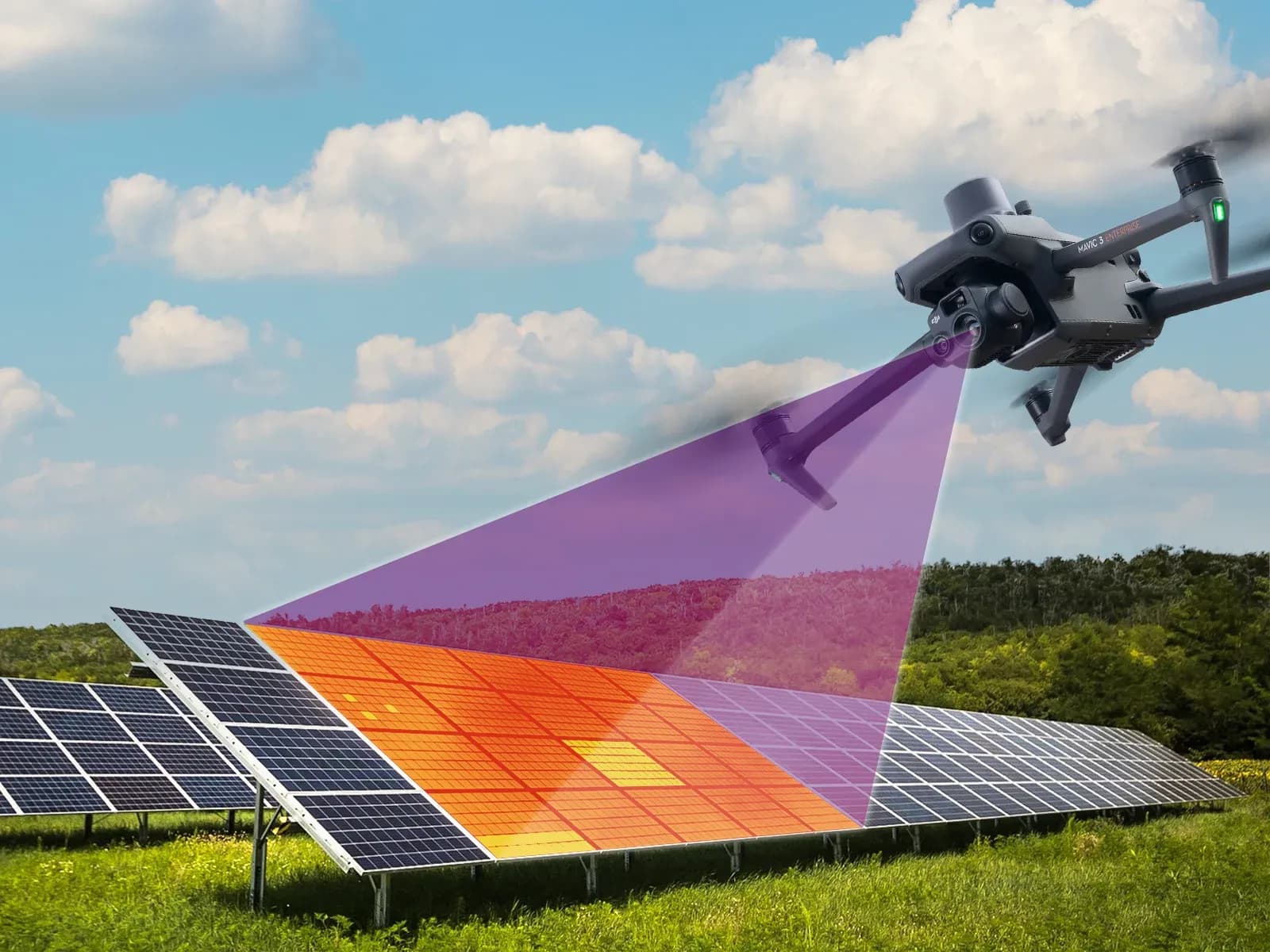
A thermal camera measures infrared radiation to estimate apparent surface temperature. A hot spot is a finding to investigate, not automatic proof of a failed module. Visual context and appropriate field tests help distinguish possible causes.
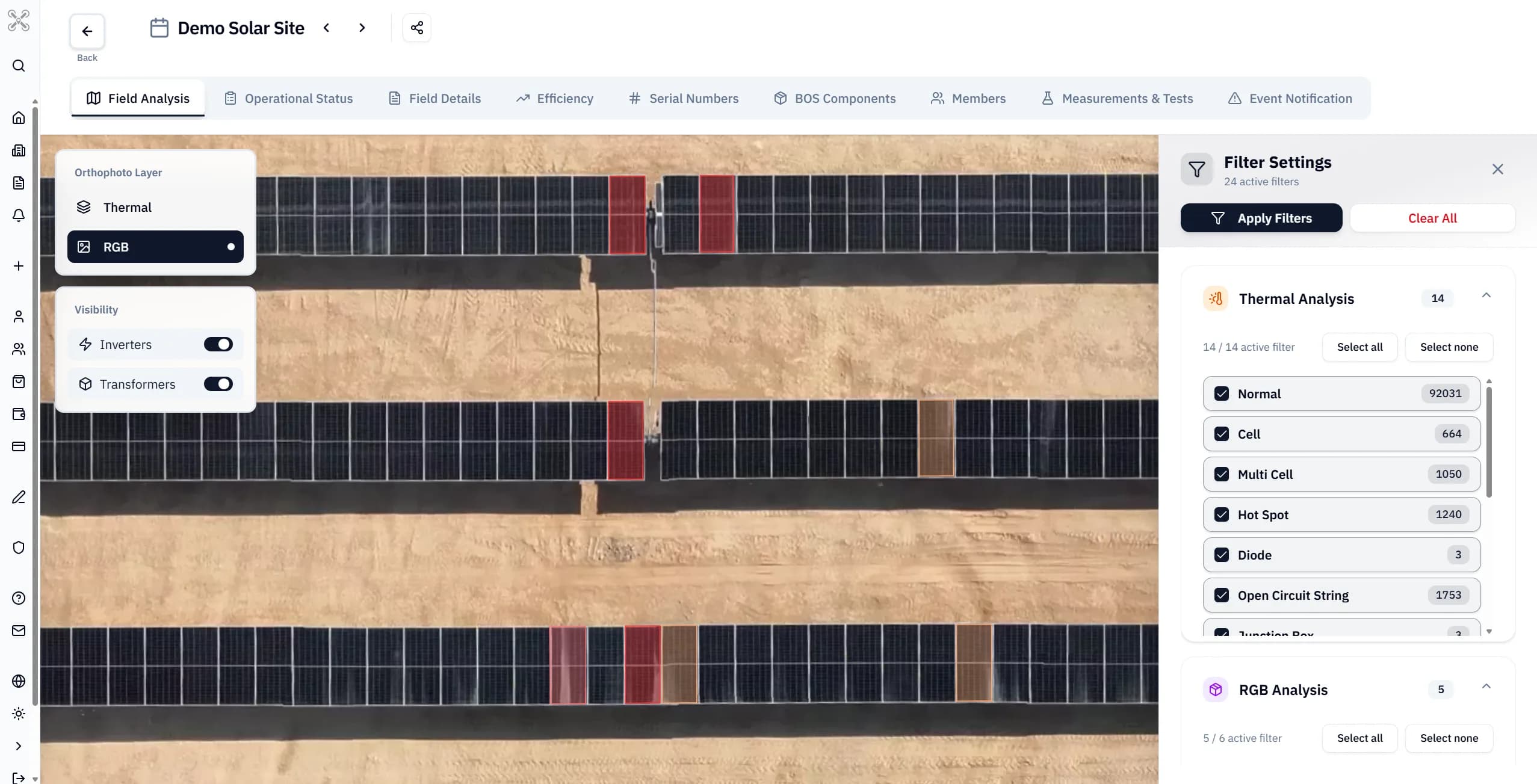
Inspection with a thermal camera in solar power plants is usually done with a drone. The drone flies close to the solar panels and acquires thermal images. The data is then transferred to a MapperX software and analyzed in detail.
Advantages of Drone Thermographic Inspection in Solar Power Plants
Examination with a drone and thermal camera has many advantages. Some of these advantages include:
It is fast and efficient: The drone can scan a large area of solar panels in a short time. This allows for a faster and more efficient inspection than traditional methods.
Contactless: The drone performs the inspection without touching the solar panels. This reduces the risk of damaging PV panels.
A large area can be reached: The drone can also inspect hard-to-reach areas of solar panels.
Stages of Thermographic Inspection with Drone in Solar Power Plants
- Inspection of solar power plants with a drone and thermal camera includes the following stages:
- Weather check: assess flight safety and thermal acquisition conditions against the equipment limits and agreed inspection procedure.
- Preparation of the drone: The drone must be equipped with the necessary thermal camera and other equipment.
- Flying the drone: Thermal images are acquired by flying the drone over the solar panels in accordance with MapperX’s flight instructions.
- Analyzing the images: The acquired images are transferred to a cloud and analyzed.
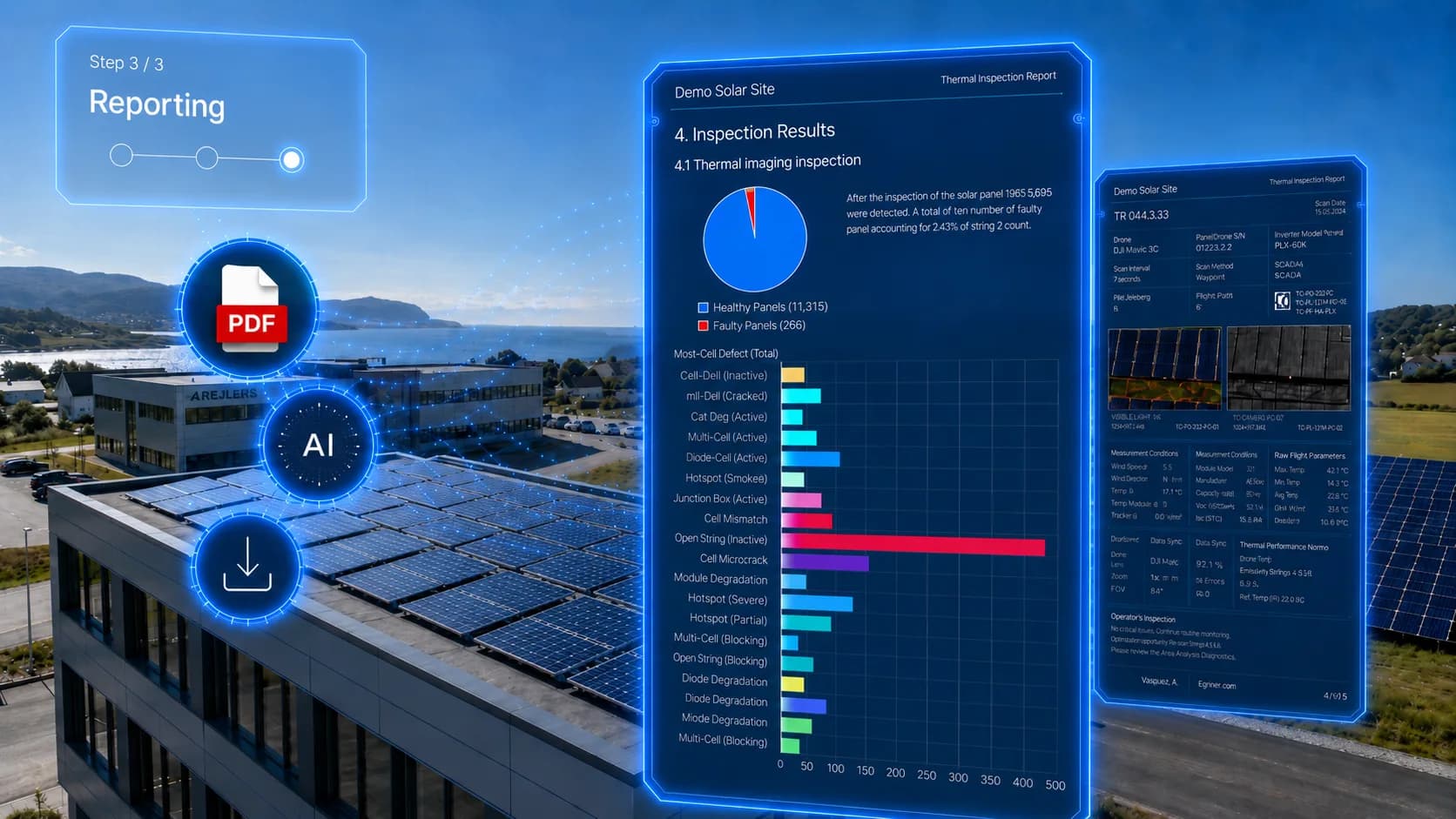
- Reporting: Analysis results are presented to the relevant parties in a detailed report with MapperX.
For the field workflow and coverage requirements, see drone solar panel inspection. For the evidence needed beyond screening, see detailed thermal inspection.
Solar panel inspection cost depends on the size and layout of the PV site, inspection method, travel, data processing, reporting depth and whether electrical verification is included. Drone thermography can reduce field time on large plants, while detailed engineering reports and follow-up tests add work beyond image collection.
How to Compare Solar Inspection Quotes
A useful quote should state what is actually included: site coverage, thermal and visual acquisition, inspection conditions, anomaly mapping, report format, electrical tests, travel and any reinspection. Comparing only a single price per megawatt can be misleading when deliverables and verification depth differ.
A price comparison cannot tell you whether the data behind a report was good enough to trust. Positioning accuracy, coverage completeness, thermal file integrity and irradiance stability all decide whether findings are reliable, and none of them appear on an invoice. A campaign flown with degraded positioning can place findings on neighboring modules. Incomplete coverage silently omits strings. Unstable irradiance makes two passes over the same block disagree.
One question separates offers more reliably than price does: what are your re-flight criteria, and who pays when they are triggered. A provider with written criteria is telling you the data gets checked. A provider with none is telling you the risk is yours.
One boundary is worth stating plainly in any procurement document. Aerial thermography and automated analysis are technical decision support: they locate and classify thermal patterns quickly across an entire plant, and qualified personnel with test equipment confirm what those patterns mean.
Information to Send with an Inspection Quote Request
Provide the site location, DC capacity or module count, layout, roof or ground-mount arrangement, access restrictions and desired completion window. Include known faults, current drawings and whether suitable thermal data already exists. State the purpose: routine screening, commissioning, a warranty investigation and post-repair verification can require different levels of evidence.
- Coverage: all accessible modules or a defined sample, plus any balance-of-system equipment.
- Deliverables: original images, mapped findings, engineering review and the required report or export.
- Field work: included electrical tests, isolation coordination and responsibility for confirming findings.
- Contingencies: weather delays, repeat flights, rejected customer-supplied data and reinspection after repair.
Compare the full job cost as well as any per-MW rate. A small or fragmented site can have substantial mobilization effort, while multiple nearby sites may share some travel costs. Ask when extra charges require approval and whether quoted prices include travel and applicable taxes.
DOE’s O&M planning guidance emphasizes defined maintenance tasks, reporting and repair verification. Use the same principle for procurement: a lower survey price is not necessarily lower total cost if the quote excludes the analysis or follow-up needed to make a decision.
An RFP should also force every bidder onto the same scope before it asks for a number. Ask which analysis level and ground sample distance the price assumes, and what the next level up costs. Ask whether the deliverable is a screening summary or a report structured to a published inspection standard. Ask whether field verification is included, priced per finding or excluded. Ask what the re-flight criteria are, who judges them, and who pays. Ask whether you receive structured findings and imagery or only a document. Ask whether a multi site portfolio is priced as one mobilization program or site by site.
When two bidders answer those six identically, the remaining price difference is a genuine commercial difference. Until then the totals are measuring different work, and the cheaper one is usually cheaper because something in the list is missing.
Which Pricing Models Do Providers Use?
Four pricing models dominate commercial solar inspection, and each one rewards a different buying pattern.
Fixed scope per campaign. The provider prices one defined campaign on one site: agreed resolution, agreed deliverable, agreed dates. Easiest to approve as a budget line, hardest to scale across a portfolio, and the model most likely to hide follow up work outside the quoted figure.
Rate per installed capacity. A rate per megawatt, sometimes banded by plant size. Convenient for portfolio budgeting, but meaningless without a stated resolution and deliverable, because the same megawatt can be screened coarsely or documented in full against a published standard.
Rate per module or per string. Common in rooftop and distributed portfolios where capacity is a poor proxy for effort. It prices the analysis honestly and prices the mobilization badly, so it works best when many small sites are clustered into one visit.
Credit or subscription based analysis. The capture is procured separately, and analysis is drawn against a credit balance or a subscription. This decouples inspection frequency from a fixed annual contract, so screening cadence can follow each site's risk profile. MapperX plans work this way, and the MapperX platform documents the flight parameters each supported drone model needs for a given analysis level.
The model matters less than the scope attached to it. A rate per megawatt with a documented resolution, deliverable and verification policy is a better purchase than a fixed campaign price with none of them.
- How work is counted: Fixed scope per campaign (One defined campaign on one site); Rate per installed capacity (Capacity in scope, sometimes banded by plant size); Credit or subscription based analysis (Analysis drawn against a balance as campaigns run)
- Budget behavior: Fixed scope per campaign (Single approvable line, easy to forecast); Rate per installed capacity (Scales cleanly across a portfolio); Credit or subscription based analysis (Follows actual inspection cadence rather than a fixed year)
- Main risk of overpaying: Fixed scope per campaign (Follow up work priced outside the figure); Rate per installed capacity (Rate quoted with no stated resolution or deliverable); Credit or subscription based analysis (Buying a finer analysis level than the question needs)
- Best fit: Fixed scope per campaign (One site, one clearly bounded question); Rate per installed capacity (Multi site portfolio with uniform plant types); Credit or subscription based analysis (Risk based cadence that differs site by site)
- Question to ask first: Fixed scope per campaign (What is excluded from this figure?); Rate per installed capacity (Which resolution and deliverable does the rate assume?); Credit or subscription based analysis (What does one campaign at each analysis level consume?)
What Sits Inside and Outside a Typical Scope?
The scope boundary is where commercial disappointment happens, and it is almost always one of five lines. Ask about each of them explicitly before comparing totals.
- Resolution and analysis level. Ground sample distance, the distance on the ground represented by a single image pixel, is the most predictable cost lever in the quote. A finer setting means lower flight altitude, more flight lines, more frames and more processing per module. MapperX documents 3 cm and 5 cm analysis workflows, and buying the finest available setting for routine monitoring is a common way to overpay.
- Reporting standard. A summary that marks warm areas on an orthophoto and a report structured to IEC 62446-3 are different products built from the same flight. The standard expects capture conditions, equipment, method and an abnormality class with a recommended action per finding, and assembling that consumes analyst and reviewer time.
- Field verification. Aerial screening localizes and classifies a suspected fault; it does not confirm the electrical root cause. Confirming a bypass diode failure, a string outage or connector heating requires qualified personnel on site with test equipment. Some providers include a verification day, some price it per finding, some exclude it entirely.
- Re-flights and data quality. Unstable irradiance, incomplete coverage or degraded positioning can invalidate a dataset. Who decides that the criteria were missed, and who pays for the return visit, is a contract term and not a technical one.
- Data ownership. Whether you receive structured findings and the underlying imagery, or only a rendered document, affects how reliably and efficiently next year's campaign can be compared against this one.
How Do You Build an ROI Model Without Inventing Numbers?
An honest inspection ROI model is built from your own operating figures, not from a published payback percentage. Any generic payback claim silently assumes a tariff, a plant size, a fault prevalence and a repair cost, and if even one of those assumptions is wrong the number is marketing rather than analysis. That is why this article publishes none.
The model needs eight inputs, all of which you either already hold or can obtain from your own records: installed capacity in the scope, expected annual specific yield for the site, the revenue rate per unit of energy under your tariff or offtake agreement, the share of capacity you estimate is affected by undetected faults, the average time a fault stays undetected under your current inspection cadence, the average cost of the corrective work each fault class requires, the cost of the inspection campaign itself, and the remaining time on module and inverter warranties.
Those combine into three value streams rather than one number. Recovered production is capacity that resumes generating once located and repaired, and it is the stream your yield and tariff figures price directly. Avoided risk covers fault classes with a safety dimension, notably hotspots and junction box heating, where the relevant question is exposure rather than yield. Preserved warranty claims are the most time sensitive stream, because module level evidence collected while a warranty window is open can support a claim that becomes worthless once the window closes.
Failure mode prevalence is the input people guess at hardest. The honest source is fleet data rather than a vendor estimate: IEA PVPS Task 13 has published reviews of how frequently individual failure modes occur across operating photovoltaic fleets, which is a defensible basis for the affected share input above.
Run the model for all four combinations of two inspection cadences and two analysis levels. The output that matters is not a payback figure, it is which of the four scenarios changes your decision. If none of them do, buy the cheapest scope that produces module level evidence, and revisit after one campaign of real findings.
- Pricing basis: Scope of qualified work delivered, not module count alone
- Cost pools in a quote: Field work, analysis, reporting, follow up
- Pricing models in use: Per campaign, per installed capacity, per module or string, credit or subscription based
- Largest hidden variable: Whether field verification and re-flights sit inside the quoted figure
- Most predictable cost lever: Ground sample distance and analysis level, documented at 3 cm and 5 cm workflows
- Reporting reference: IEC 62446-3 for outdoor infrared thermography content and classification
- ROI model inputs: Eight, all taken from your own operating and warranty records
- Prevalence source: Fleet level failure mode reviews rather than vendor recovery estimates
When Does a Deeper Scope Pay for Itself?
A deeper inspection scope pays for itself when the cost of being wrong about a finding exceeds the cost of documenting it properly. Four situations meet that test reliably: an open warranty or performance guarantee where evidence has a deadline, an acquisition or refinancing where a third party will scrutinize the condition record, a dispute with an EPC or module supplier, and a site whose production shortfall is already large enough to fund the work.
Outside those situations, a screening pass that establishes a reference state is usually the better purchase. It answers whether findings cluster anywhere on the site and whether a deeper campaign is justified at all, and its value depends far more on findings being anchored to module identity than on resolution. A cheap campaign that produces comparable data beats an expensive campaign that produces a static document.
Quick FAQ
Is drone solar inspection always cheaper than manual inspection?
Not always. Drones can reduce field time on large sites, but total cost still depends on mobilization, data quality requirements, analysis, reporting and any follow-up testing.
Can I pay only for analysis if I already have drone images?
Potentially, but first confirm that the original files, thermal detail, location data and acquisition conditions meet the analysis requirements. Unusable imagery may require another survey, so validate a sample before assuming acquisition cost is avoided.
Should a quote include reinspection after repairs?
It should state whether reinspection is included, optional or separately priced. Define the affected area and evidence needed to verify the repair so that closure is not confused with the initial survey.
Is a price per megawatt enough to compare providers?
No. Check the capacity basis, coverage, image detail, review depth, reports, field tests and travel assumptions. Identical rates can purchase substantially different levels of inspection.
Glossary
- Mobilization: The fixed cost of getting a qualified crew and equipment to a site, including travel, airspace coordination, permissions and safety induction. It is incurred per visit regardless of how much capacity is inspected.
- Scope normalization: The step of restating two quotes against identical resolution, deliverable, verification and data ownership terms so that their totals describe the same work. Without it, price comparison is meaningless.
- Rate per installed capacity: A price expressed per megawatt of capacity in scope. It is only interpretable when paired with a stated analysis level and deliverable, because the same capacity can be screened or fully documented.
- Credit based analysis: A pricing model in which analysis is drawn against a purchased balance rather than a fixed annual contract, allowing inspection frequency to follow each site's risk profile.
- Acceptance criteria: The written conditions a delivered inspection has to meet before it is accepted and paid, covering coverage completeness, data quality, report structure and the evidence attached to each finding.
- Detection lag: The average time a fault remains undetected under the current inspection cadence. It converts a fault into lost energy, and it is the input that inspection frequency changes most directly.
- Recovered production: Capacity that resumes generating after a located fault is repaired. It is one of three ROI streams, alongside avoided safety risk and preserved warranty claims.
Sources
- IEC: IEC 62446-3:2017, Outdoor infrared thermography of PV systems (2017)
- IEC: IEC 62446-1, Grid connected PV systems: documentation, commissioning tests and inspection
- IEA PVPS Task 13: Review of Failures of Photovoltaic Modules
- IEA PVPS Task 13: Performance, Operation and Reliability of Photovoltaic Systems (publications)
- MapperX: Knowledge base (first-party product documentation)