
Drone resource
DJI M30T for Drone Solar Panel Inspection
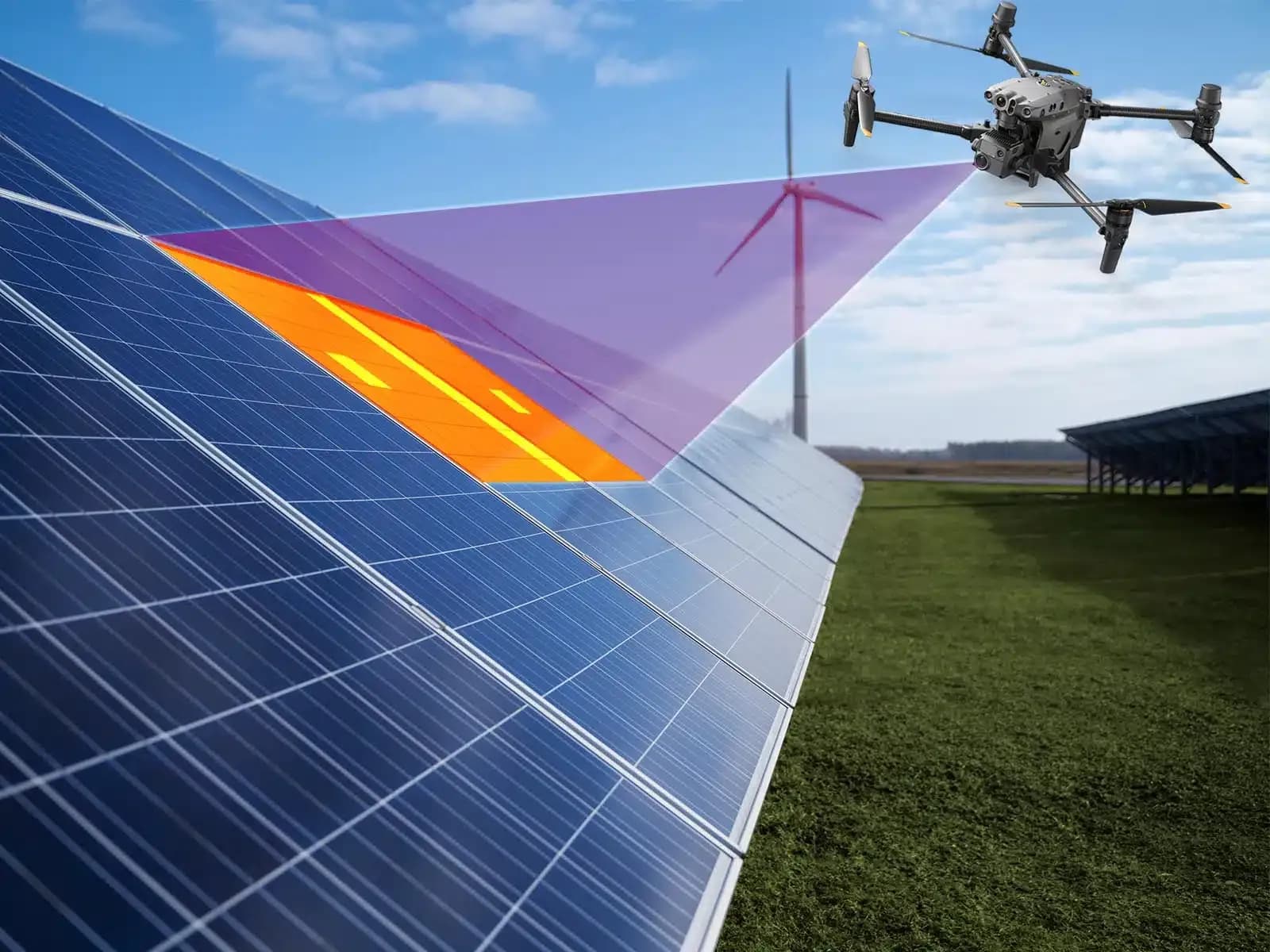
The DJI Matrice 30T, commonly called the M30T, is a rugged enterprise drone for thermal and visual solar panel inspection. It combines a 640 x 512 thermal camera, wide and zoom cameras, a laser rangefinder, RTK positioning and IP55 protection in a compact folding aircraft. DJI’s published maximum flight time is 41 minutes with 1671 propellers or 38 minutes with 1676 propellers under the manufacturer’s test conditions, not guaranteed inspection endurance. DJI source: Source
DJI M30T Specifications for Solar Panel Inspection
The M30T specification sheet is useful only when each number is connected to an inspection decision. Thermal resolution affects the detail available in an infrared frame. Flight time and aircraft speed affect possible site coverage. Wind resistance, ingress protection and operating temperature define practical limits, but they do not remove the need to inspect under suitable thermography conditions.
- Aircraft weight with two batteries: approximately 3.77 kg
- Thermal imager: uncooled VOx microbolometer
- Thermal image resolution: 640 x 512 normal mode; 1280 x 1024 super-resolution
- Published temperature measurement accuracy: ±2 °C or ±2% (whichever is greater), under DJI’s specified measurement conditions.
- Wide camera: 12 MP; zoom camera: 48 MP
- Published maximum flight time: 41 minutes with 1671 propellers (38 minutes with 1676 propellers), under the manufacturer’s test conditions. DJI source: Source
- Published maximum horizontal speed: 23 m/s
- Published maximum wind resistance: 12 m/s
- Ingress protection: IP55
- Operating temperature: -20 C to 50 C
Battery, controller and mission support
- The aircraft uses two TB30 batteries, each rated at 5880 mAh; DJI lists a self-heating function for suitable cold-weather preparation.
- DJI RC Plus has a 7-inch screen and IP54 protection. Aircraft IP55 and controller IP54 are different ratings and remain subject to DJI operating conditions.
- The 48 MP zoom camera provides 5× to 16× optical zoom. The thermal camera records 640×512 at 30 fps in normal mode; super-resolution output is not a higher native detector resolution.
- The M30 series supports DJI AirSense and compatible D-RTK 2 workflows. Obstacle sensing and positioning assistance do not remove the need for site-specific flight planning.
DJI publishes maximum performance values under defined test conditions. Real inspection endurance is lower after accounting for wind, temperature, reserve battery, maneuvering, return-to-home requirements and the overlap needed for the selected workflow. These figures should be treated as planning references, not guaranteed field output.
Why the M30T Fits Utility-Scale Solar Inspection
The M30T sits between smaller portable thermal drones and larger modular enterprise platforms. Its folding body is easier to transport than a heavy-lift system, while its weather protection, integrated sensor package and enterprise controller make it suitable for repeated field deployment. That balance is useful for O&M teams inspecting large ground-mounted plants, industrial rooftops and distributed portfolios.
When the M30T is a strong operational fit
- Large ground-mounted PV sites and repeated portfolio inspections
- Operations that need thermal and visual sensors on one aircraft
- Field teams working across a broad operating temperature range
- Workflows that benefit from RTK positioning and enterprise flight tools
When a smaller aircraft may be more practical
A lighter platform such as the DJI Mavic 3 Thermal may be easier to deploy for small rooftops, constrained takeoff areas or teams that prioritize minimum equipment weight. The M30T becomes more attractive when environmental tolerance, controller endurance, integrated enterprise features or repeated utility-scale operations matter more than minimum size.
M30T Thermal, Wide and Zoom Camera System
The M30T combines four sensing functions in one fixed gimbal assembly: a wide camera, a zoom camera, a laser rangefinder and a thermal camera. The thermal channel supports temperature measurement and helps locate abnormal patterns. The visual channels provide context that can help distinguish physical damage, debris, shadows, vegetation, reflections and other conditions around a thermal observation.
Thermal camera capability
The uncooled VOx thermal imager records 640 x 512 imagery in normal mode and supports 1280 x 1024 infrared super-resolution output. DJI lists spot and area temperature measurement and a published accuracy of plus or minus 2 C or plus or minus 2 percent, whichever is larger. Accuracy still depends on the stated operating conditions and correct acquisition practice.
Wide camera, zoom camera and laser rangefinder
The M30T includes a 12 MP wide camera and a 48 MP zoom camera. Visual imagery is not a substitute for thermography, but it is valuable evidence when reviewing a suspected module, string or surrounding site condition. The laser rangefinder is useful for situational awareness and target location in general enterprise operations, although PV mapping should rely on the inspection workflow and georeferenced dataset rather than a single range reading.
Flight Planning for M30T Solar Panel Inspection
A good M30T solar inspection begins with the required output, not with the aircraft. The team should define whether the job is a rapid thermal screen, a detailed mapped inspection, a commissioning check or a repeat survey. That decision determines altitude, ground sampling distance, flight speed, image overlap, viewing geometry and the amount of visual data required.
Acquisition conditions that affect PV thermography
- Adequate solar irradiance and an operating PV array
- Wind low enough for stable, repeatable image capture
- Viewing angles that limit reflection and self-shadowing
- Correct focus, altitude, speed and image overlap
- A documented flight plan and complete site coverage
Check data quality before leaving the site
Before demobilization, review focus, exposure, thermal contrast, coverage and file completeness. A technically capable drone cannot compensate for blurred imagery, missed rows, severe reflections or a flight completed under unusable environmental conditions. A short field quality check is cheaper than returning to the plant for a second acquisition.
What M30T Drone Inspection Can and Cannot Show
Drone thermography is effective at finding and locating temperature patterns across a large PV array. It can reveal modules or areas that deserve attention and can make a full-site review more systematic than manual spot checking. The thermal image is evidence of temperature behavior, not automatic proof of the electrical root cause.
Where aerial thermal inspection is strongest
- Screening large numbers of modules efficiently
- Locating hot or cold patterns on the plant map
- Providing thermal and visual evidence for technical review
- Prioritizing modules or areas for field verification
Where field verification is still required
A hot or cold pattern may be associated with several possible conditions. When a finding affects production, safety, warranty or repair decisions, technicians may need visual inspection, voltage and current measurements, insulation testing, continuity testing or I-V curve tracing. The correct follow-up depends on the pattern and the plant design.
How MapperX Processes DJI M30T Inspection Data
MapperX organizes thermal and visual inspection imagery into a location-aware review workflow. Instead of leaving the team with an unstructured image folder, the platform associates inspection evidence with the plant layout, supports anomaly review and produces outputs that can be used for reporting and maintenance follow-up.
Mapped anomaly review in the platform
From candidate anomaly to field action
The useful end product is a finding that can be located, reviewed and acted on. O&M teams can use the mapped evidence to prioritize field checks, record the result of verification and decide whether cleaning, electrical diagnosis, repair, replacement or later observation is appropriate.
M30, M30T and DJI Dock Version Differences
The standard M30 sensor package includes the wide camera, zoom camera and laser rangefinder. The M30T adds the thermal camera required for infrared inspection. DJI also distinguishes regular aircraft from Dock versions. A regular M30T is not the same hardware configuration as an M30T supplied for DJI Dock, so automated dock deployment should be planned around the compatible version.
Technical Sources and Related Solar Inspection Guides
DJI M30T Solar Inspection FAQ
Is the DJI M30T suitable for solar panel inspection?
Yes. The M30T combines thermal and visual cameras, RTK positioning, enterprise flight features and a folding IP55 aircraft. It is particularly useful where teams need a durable platform for repeated or utility-scale PV inspection work.
What thermal camera resolution does the M30T use?
The M30T thermal camera records 640 x 512 imagery in normal mode and supports 1280 x 1024 infrared super-resolution output.
What is the official M30T wind resistance rating?
DJI currently lists maximum wind resistance of 12 m/s for the Matrice 30 Series. Inspection teams should use a more conservative operational limit when image stability, local rules or thermography conditions require it.
Can the DJI M30T identify the exact cause of a faulty panel?
It can capture and locate abnormal thermal patterns. Determining the exact cause may require visual inspection or electrical tests because different conditions can produce similar temperature behavior.
Does MapperX support DJI M30T inspection imagery?
Yes. MapperX can organize M30T thermal and visual inspection imagery into mapped outputs for anomaly review, reporting and maintenance follow-up.